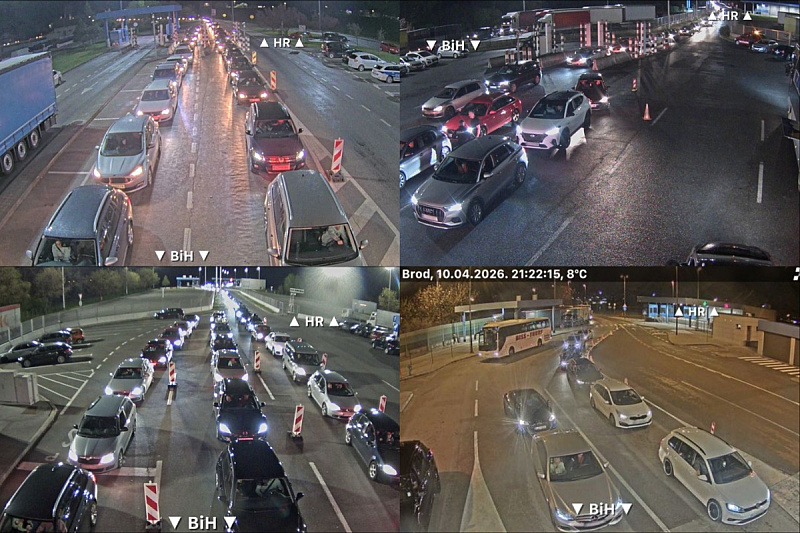
According to BIHAMK, due to passenger registration under the new European Union entry/exit system (EES), longer waits at border crossings are possible. At other crossings, delays for passenger vehicles do not exceed 30 minutes.
The Croatian Automobile Club also notes increased traffic at most border crossings with Bosnia and Herzegovina, Serbia, and Montenegro due to the new system.
Assistant Police Director and Head of the Border Administration Zoran Ničeno acknowledged to HRT that this system requires additional time. "The check takes about a minute, 70 seconds, depending on how familiar the person is with using the device," he said.
He emphasized that particular challenges exist at road crossings, where passengers must exit their vehicles and undergo scanning. Police plan to alleviate congestion by using mobile devices. "We are already using mobile devices and will deploy them additionally during weekends and the tourist season, both at road crossings and airports," Ničeno announced.
He also commented on congestion at certain crossings. "I wouldn’t say the congestion is caused by the Entry/Exit System. At Bajakovo, waits were around three hours, but that was on the Friday before Orthodox Easter, when such travel is common," he added.
Recall that European Union member states are now fully implementing the Entry/Exit System (EES), marking the end of its phased rollout and transitioning to fully digital tracking of external Schengen border crossings.
This means that passport stamps for third-country nationals will no longer be used; instead, all entry and exit data will be recorded electronically in the EES system.
According to HAK information, travelers at the Gradiška crossing are waiting up to three hours, and about an hour and a half at the Bosanska Kostajnica - Hrvatska Kostajnica crossing, as well as Ličko Petrovo Selo - Izačić.