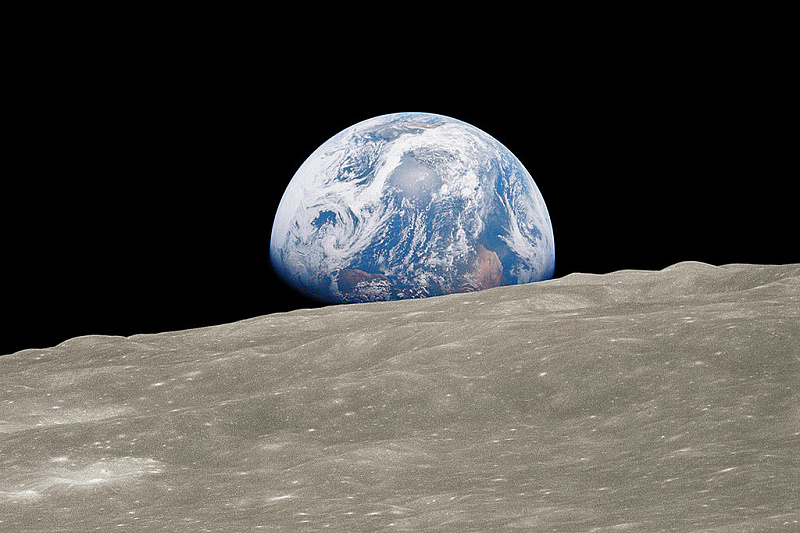
The lens used to capture the photograph was the Zeiss Sonnar 250mm f/5.6, produced by the German company Carl Zeiss, which we wrote about during our museum visit. This lens was chosen because it allowed photographing Earth from a great distance with very high image sharpness. Interestingly, one of the most famous photographs in human history was taken using a combination of the Swedish Hasselblad camera and German Zeiss optics. At that time, astronauts had only a few cameras and a limited number of film rolls, making each photograph extremely valuable. As time passed, technology itself advanced. Earthrise vol. 2 could be repeated in a somewhat different form, but the Artemis II crew members have already taken fascinating photographs of Earth from space. Indeed, more than half a century after the Earthrise photograph, astronauts of the Artemis II mission are once again photographing Earth on their way to the Moon, but now with completely different technology. The Earth photographs released by NASA were taken from the Orion capsule as the spacecraft moved away from Earth and headed toward the Moon. These photographs were captured using digital professional Nikon cameras and various lenses, and the images are transmitted to NASA headquarters in milliseconds. During the mission, laser communication is also used, and hundreds of gigabytes of data, including photographs and videos, have already been sent from the Orion spacecraft. Unlike the Apollo missions, Orion today has a large number of cameras—professional cameras, GoPro cameras mounted on the capsule’s solar wings, as well as numerous internal and external cameras recording the entire mission. The difference between the Apollo and Artemis missions is best seen precisely in the photographs of Earth. More than 50 years ago, astronauts used analog cameras and film, photographs were developed only after their return, and relatively few images were captured. Today, astronauts use high-resolution digital cameras, photographs are immediately sent to Earth, and the entire mission is recorded by dozens of cameras from all angles. However, despite enormous technological progress, the message of the photographs has remained the same as in 1968. Earth from space looks like a small, fragile blue world in infinite space, which many astronauts describe as one of the most powerful experiences a human can have.
Society
From Earthrise to Artemis II: How the Most Famous Photographs of Earth from Space Were Created
When the astronauts of the Apollo 8 mission first orbited the Moon in 1968, they had no idea they were about to take one of the most famous photographs in human history. The image, known as Earthrise, shows Earth rising above the lunar horizon and changed the way people view their planet. The crew members of the Artemis II mission have just taken the first of what will likely be many incredible photographs of Earth from space.
ingestion