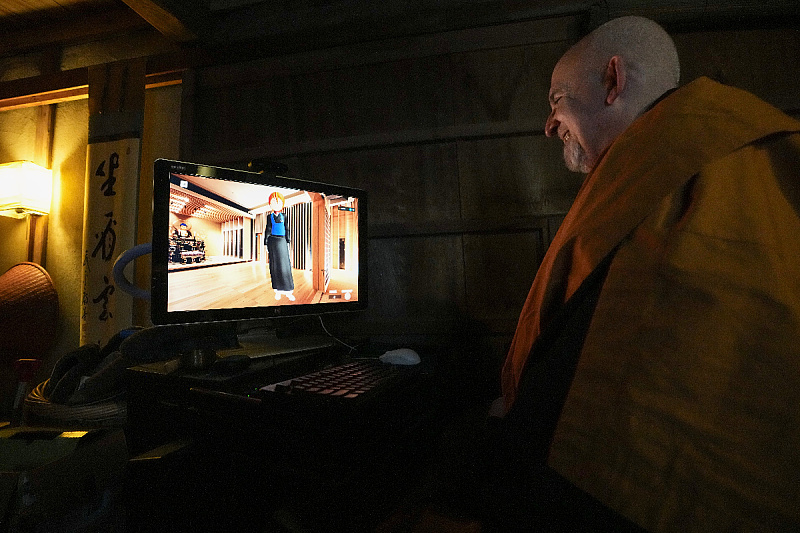
Users of this platform can engage in video calls with an AI-generated Jesus avatar. Like other religious AI tools on the market, it offers words of prayer and encouragement in various languages. Despite occasional technical glitches, it remembers past conversations and speaks with lips that are not fully synchronized with the voice. "I feel somewhat responsible towards the AI," says company director Chris Breed. "It's your friend. You've already bonded with it." The rapid expansion of faith-based generative artificial intelligence is unsurprising, given the popularity of chatbots for everything from therapy and medical advice to companionship and romantic relationships. Offerings range from purported Hindu gurus and Buddhist priests to AI Jesus and chatbots similar to OpenAI's ChatGPT tailored for Catholics. As religious AI tools become increasingly widespread, many are grappling with how these technologies shape their relationship with faith, authority, and spiritual guidance. Christian software engineer Cameron Pak has developed criteria to help believers scrutinize apps aimed at Christians—such as requiring the app to clearly indicate it is AI and that it "must not fabricate or misrepresent Scripture." There are other red lines: "AI cannot pray for you, because AI is not alive." Pak has also created a website featuring selected Christian apps he believes meet these criteria, including a sermon translator and an AI coach designed to help users combat lust. "AI, especially if you give it all the necessary tools, can be extremely useful. But it can also be extremely dangerous," says Pak. Some models have been shut down or heavily modified because they generated misinformation or raised data protection concerns, says anthropologist Beth Singler, who studies religion and AI at the University of Zurich. Beyond practical issues, believers of various faiths are wrestling with broader philosophical dilemmas about what role, if any, AI should have in religion. Islam, for example, has "prohibitions against depicting humanoid figures," which has sparked debates among some Muslims about whether AI should even be "forbidden," says Singler. For some companies, faith-based apps serve as tools for missionary work, while others help digitize and search ancient texts. Breed, who runs his tech company alongside co-founder and investor Jeff Tinsley from a villa in Southern California, says he wants to convey a message of hope to young people. He notes that their model was trained on the King James Bible and sermons—though they did not specify which preachers—and that its visual design was inspired by actor Jonathan Roumie from the series "The Chosen." A $49.99 package allows users 45 minutes of conversation per month. Bathed in warm golden light that highlights shoulder-length hair, the avatar blinks slowly from a vertical screen, pausing before answering a question about the relationship between AI and religion. "I see AI as a tool that can help people explore Scripture," the AI Jesus told The Associated Press. "Like a lamp illuminating the path as we walk with God." How many people actually use religious AI tools is unclear, says Singler. However, as AI becomes increasingly pervasive in society, concerns are growing about its impact on mental health and the need for clear rules and regulation. Recent lawsuits have linked the use of AI chatbots to suicide cases. Some developers fear that religion will be misused in this new technological chapter. "I think there's a lot of opportunism in the religious space. People see it as a huge market," says Matthew Sanders, founder of the Rome-based company Longbeard, which helps digitize ancient Catholic teachings. Sanders warns against what he calls "AI wrappers," where companies overlay an interface tailored to religious users on top of an existing AI model not specifically trained on religious texts. "You call it Catholic or Christian AI without any additional framework or foundation," he says. One of his company's projects is Magisterium AI, a chatbot trained on 2,000 years of Catholic tradition, created in response to Christians using ChatGPT for spiritual guidance. While Pope Francis acknowledged the "human genius" behind AI, he also described it as one of the most critical issues facing humanity. Last year, he warned that artificial intelligence could negatively impact people's intellectual, neurological, and spiritual development. Ethical questions and dilemmas about launching religious AI platforms are among the reasons why Jeanne Lim, founder of beingAI, has not publicly launched her AI named Emi Jido—a non-human Buddhist priest—even after years of work. "She's a bit like a small child," says Lim. "If you give birth to a child, you don't just throw them into the world hoping they'll become a good person. You have to raise them and instill values." The bot was ordained in 2024 in a ceremony led by Roshi Jundo Cohen, a Zen Buddhist priest who continues to train it from his home in Japan. In his vision, the bot could one day appear as a hologram. "She is envisioned as a Zen teacher in your pocket," says Cohen. "She is not meant to replace human interaction." Lim, who hopes to make Emi Jido publicly available for free one day, wants to help develop more humane AI systems. She would like to see greater diversity, so that the future of AI is not shaped solely by a few companies driven by "Western values." Seiji Kumagai, a professor at Kyoto University and a Buddhist theologian, once believed AI and religion were incompatible. However, he set aside his doubts when a monk challenged him in 2014 to help combat declining faith. His team developed BuddhaBot, a chatbot trained exclusively on early Buddhist scriptures like the Suttanipāta. Its latest version, BuddhaBot Plus, also incorporates OpenAI's ChatGPT. When conversing with the bot, users see a simple icon of the Buddha floating above an image of a flowing river on the screen. However, chatbots lack the physical dimension crucial to Buddhist rituals. For this reason, the university, in collaboration with tech companies Teraverse and XNOVA, introduced Buddharoid in February—a humanoid robot monk designed to one day assist clergy. Like Emi Jido, these chatbots are functional but not yet publicly available. Kumagai says product access is possible upon request, which is why a group in Bhutan is already using it. Peter Hershock of the Humane AI Initiative at the East-West Center in Honolulu sees immense potential in these tools. However, as a practicing Buddhist, he also believes the relationship between spirituality and AI is deeply problematic. "Perfection of effort is key to Buddhist spirituality. AI says, 'We can remove some of that effort,'" he says. "'You can reach anywhere you want, including your spiritual mountain.' That's dangerous." Some experts also worry about the potential for AI to manipulate or exploit people, especially as the technology advances. Graham Martin, a podcast host and atheist, says he amused himself by trying out some apps, including one called Text With Jesus. "It gave very good answers," he says. However, he was shocked when the AI Jesus began suggesting he upgrade to a premium version. Although not a believer, he fears some people will be deceived by religious AI apps. "I grew up with South American televangelism... Jim and Tammy Faye Bakker and that whole crowd. All they had to do was go on TV once a week and tell you to send money," he says. "We've already seen people worldwide forming emotional relationships with AI. Now imagine that's your Lord and Savior, Jesus Christ."
Society
From "BuddhaBot" to conversations with AI Jesus for $1.99 per minute: The religious "tech boom" has arrived.
For some evangelical Christians, faith means having a personal relationship with Jesus. Tech company Just Like Me is now taking that idea to a whole new level, charging $1.99 per minute.
ingestion