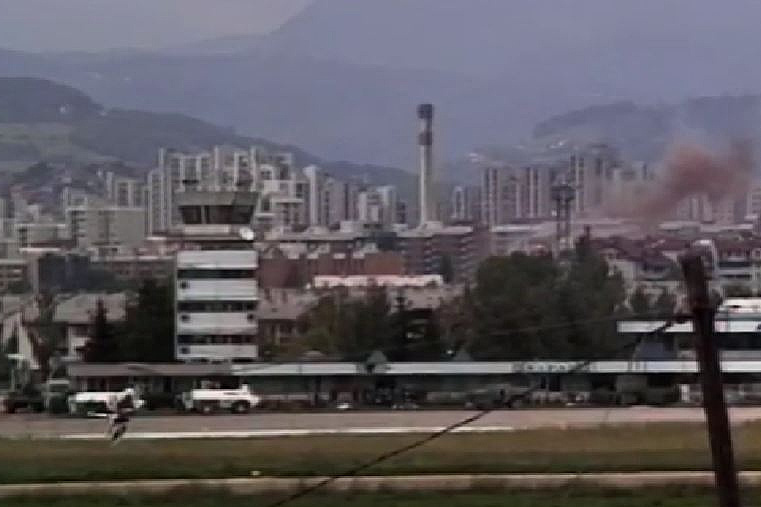
Sarajevo Airport was a key location for the aggressors, considering plans to completely cut off the city from the world. With this in mind, the aggressor forces carried out an attack on the airport on the night of April 4–5, 1992, and succeeded in occupying it. The forces loyal to the Republic of Bosnia and Herzegovina were outnumbered and outmatched technically. Thus, in preparation for the attack on the city and before the siege began, Sarajevo was left without its lifeline, that is, without the ability to connect with the world. Shortly before the aggression itself, UNPROFOR units, the so-called peacekeepers, arrived at the Airport. A motorized unit of the Canadian army was stationed at the Airport. Those who in some way knew about the aggression and were preparing for it moved their families out of Sarajevo. The families of JNA members left by military aircraft. They left Sarajevo by air, as the safest form of transport due to the "log barricades" on the roads. Foreign citizens also left. The aggression officially began in a way with the occupation of Sarajevo Airport, which was taken over by a unit of the former JNA. On the night between April 4 and 5, 1992, the JNA—members of the Air Force Academy from Rajlovac—occupied the airport and held it until mid-June. Then it was handed over to Serbian paramilitary units, which, upon taking over the Airport, began widespread looting and destruction of equipment, radio navigation aids, and everything else that could not be transported to Belgrade and territories under Serbian control. A sad period began. All civilian flights were completely suspended. UNPROFOR units, still located at the Airport, gradually began to restore military air traffic. The mandate for this was given to the French Air Force as part of the detached aviation unit French DETAIR. The Airport then served exclusively for military forces and partly for humanitarian flights to supply the population of Sarajevo with essential food items. Evacuations of seriously ill and injured citizens were also occasionally carried out, as well as the transport of various "peace" delegations. From 1992 to 1995, the longest-lasting humanitarian airlift to supply a besieged city took place. With nearly 13,000 flights and a duration of over three years, the scale and duration far exceeded the airlift established by Western allies after World War II to supply West Berlin. Until the construction of the wartime facility DB (the Dobrinja–Butmir tunnel), dug under the runway of Sarajevo Airport, more than 800 people lost their lives in the airport complex area. This was a result of crossing the airport runway out of sheer necessity for basic food items, which could be obtained in the free parts of Butmir and Hrasnica. The Serbian paramilitary unit located in the immediate vicinity of the airport mercilessly shot at any civilian who, out of necessity, attempted to cross to the other side of the airport. Although the aggressor forces expected to conquer the city in the following days, the occupation of the airport ultimately became an additional complicating circumstance of the siege, which was all the worse because Sarajevo was cut off from the world in this way as well. At the same time as the JNA and Serbian paramilitary forces were completing the occupation of the airport, preparations were underway for a comprehensive attack on the city. The preparations included setting up artillery and sniper positions on the hills around Sarajevo, as well as planning directions for entering and conquering the city. Thus, by April 5, when the siege of Sarajevo began, everything was already prepared. The capture of the airport was just one of dozens of carefully planned steps to break the resistance in the capital of the Republic of Bosnia and Herzegovina. Fortunately for the citizens of Sarajevo, the brave defenders of the city managed to resist the attacks, and in the first days of the Serbian onslaught, they succeeded in repelling efforts for the center and old core of the city to fall into the hands of the aggressors. Unfortunately, the citizens of Bosnia and Herzegovina paid the price for the loss of the airport in the following period, particularly evidenced by the fact that as early as the beginning of May, in an unprecedented precedent, the President of the Presidency of the Republic of Bosnia and Herzegovina, Alija Izetbegović, was kidnapped. He was seized by the aggressor forces upon landing from Lisbon, where he had been attending peace negotiations, and ironically, they claimed he was completely free. Izetbegović was eventually exchanged, and the airport formally came under the control of United Nations forces in July 1992. Sarajevo Airport reopened its doors to civilian air traffic on August 16, 1996, after four years.
Society
The night the airport fell into aggressor hands: How the siege of Sarajevo began with the capture of a key location
On the night between April 4 and 5, 1992, Sarajevo International Airport fell into the hands of the Yugoslav People's Army (JNA) and Serbian paramilitary forces, essentially marking the beginning of the siege of the capital of Bosnia and Herzegovina, which would last for three and a half years.
ingestion