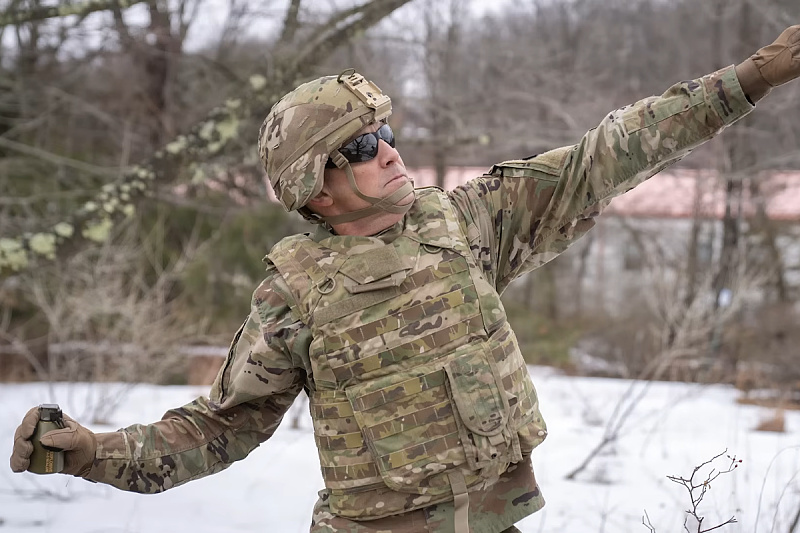
The M111 bomb is primarily designed for urban combat and clearing interior spaces in buildings, with a significantly reduced risk of collateral damage. Instead of scattering metal fragments, the M111 kills and incapacitates enemies using shockwaves, specifically blast overpressure (BOP). The military emphasizes that enemies will no longer be able to hide behind interior walls, furniture, or household appliances, which previously protected them from shrapnel.
This new cylindrical ammunition, about the size of a palm, was developed directly based on U.S. military experiences from wars in the Middle East. "One of the key lessons from door-to-door combat in Iraqi cities was that the M67 grenade was not always the right tool for the job. The risk to our soldiers on the other side of the wall was too high," said Colonel Vince Morris, project manager at Picatinny Arsenal in New Jersey.
Morris added that the BOP-based bomb can "clear" a room of enemy combatants extremely quickly, leaving them no space to hide, while simultaneously ensuring the safety of allied forces in close proximity.
Devastating Effect on the Human Body
The military also explained the terrifying principle behind this weapon: "When a high-pressure wave hits a person, it rapidly compresses and then decompresses human tissue."
For smaller explosions: Eardrums, lungs, eyes, and the digestive tract are most at risk and prone to rupture.
For stronger shockwaves: The pressure can cause severe brain damage and even limb amputations.
Interestingly, the last new hand grenade introduced by the U.S. military was the MK3A2, introduced back in 1968 during the Vietnam War. However, it was withdrawn from use within the next decade because it contained carcinogenic asbestos, whose fine fibers, when inhaled, severely damaged the lungs.
Thus, for years, U.S. troops had only the M67 fragmentation grenade available. Its main drawback in urban environments is the uncontrolled scattering of shrapnel in all directions, which can kill or injure bystanders as well as soldiers from their own unit. Its predecessors were the M26, introduced in the early 1950s, and the iconic Mk2 grenade, popularly known as the "pineapple" due to its distinctive ribbed appearance.