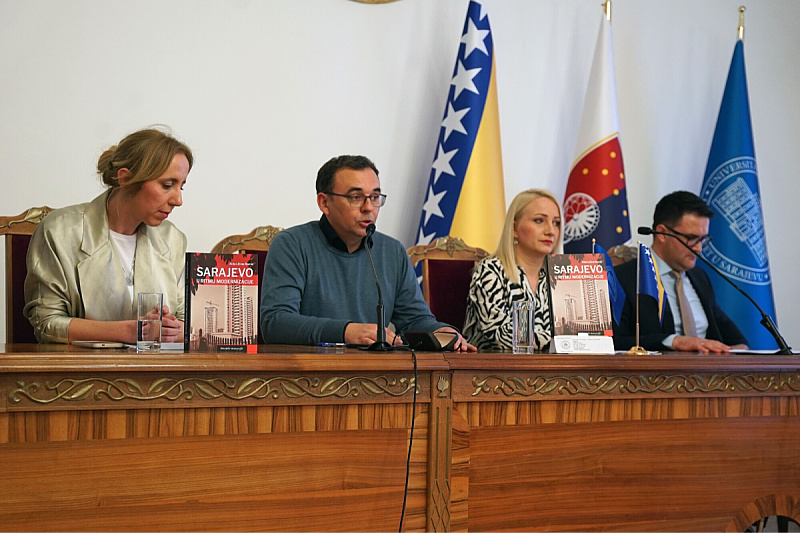
According to the author, this period is interesting to research for several reasons. Primarily, Sarajevo underwent its greatest transformation during that time in terms of construction, starting in the early 1970s when the first initiatives were launched, mainly for organizing the Winter Olympic Games. She emphasizes that the book is not solely dedicated to Olympic Sarajevo, but to Sarajevo in general, the city's development, and its population.
"Urbanization in this book is viewed not merely as the simple expansion of the city or just an increase in the urban population, but rather as a complex issue where urbanization is observed as a process that affects not only space but also people, society, how the social structure of the population transforms under the influence of these processes, as well as their everyday way of life. The focus is on the period from the early 1970s to the mid-1980s. The Olympics represented the peak of Sarajevo's development under socialism, but all these processes together contributed to Sarajevo experiencing a complete urban and social transformation during those years, which essentially defined the city's appearance as it is practically still today," she said.
The socialist period is primarily associated with modernization, urbanization, and industrialization. These are separate processes, but they intertwine. Together, they produced a series of consequences that were primarily manifested in strong population migration. Within Bosnia and Herzegovina, from 1945 onward, the population intensively moved towards larger cities due to the development of industry, which was mainly located in larger urban centers. This is actually the moment that most shaped Bosnian-Herzegovinian society, and Sarajevo in particular, as it is the capital and the economic, educational, political, and social center.
In this sense, Sarajevo is a specific example and, according to Dr. Ličina Ramić, can be compared with other cities in BiH, as well as other centers, to track the processes of socialist urbanization throughout Yugoslavia. Historian Aida Ličina Ramić intensively researched this period and speaks about the contemporary context from the perspective of personal experience.
"We can observe Sarajevo today from the perspective of socialist development because, for example, the trolleybus network in Sarajevo was formed then, the tram line was renovated within the framework we know today, but at that time, some projects that are being realized today were conceptually laid out, such as the tram line to Hrasnica, the renewal of the trolleybus line to Vogošća, and similar. The city had many problems during that period, such as illegal construction, an issue that is still relevant today and which the authorities struggled with even then. I would say these are consequences that we somewhat feel in our society today, or in the space that surrounds us," Ličina Ramić emphasized in a statement to journalists. This book is the result of work on her doctoral dissertation, as well as her work afterward, as she defended her doctoral dissertation in 2020. It was a multi-year research project.
Assistant Professor at the Faculty of Architecture, Lejla Kreševljaković, points out that the importance of this book lies in its treatment of a period that is close to many but not extensively covered scientifically.
"From the perspective of architecture and the protection of modern heritage, this is essential for us because we daily witness the destruction of this valuable heritage. We are actually not aware of these values, but the only way we can become aware of them is through such a scientific approach, in a sense of valorizing that type of heritage," says Kreševljaković, the promoter of the book.
Promoter Professor Amir Duranović also highlights the significance of the book from several different perspectives. He referred to the historiographical perspective, in terms of researching urban transformations and all that they entail.
The book, as such, fits into the model that already exists in neighboring historiographies. This is how it has been written in Slovenia, Croatia, and Serbia for years. This then situates Bosnian-Herzegovinian historiography in that regional context on some equal footing, so that we can have qualitatively equal conversations with colleagues in the region. This, as Professor Duranović said, is very necessary for our historiography because it must develop, and it can only develop if it is compared with others, primarily the neighborhood and then the broader context.