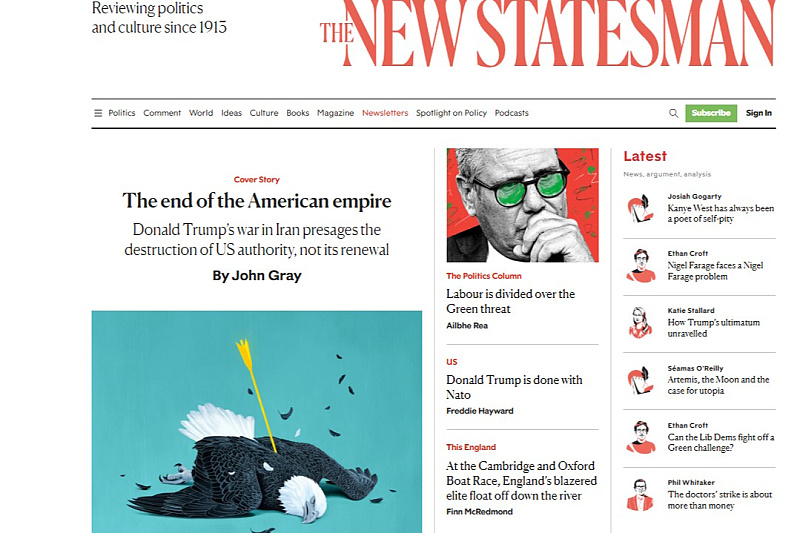
Gray reports that Trump's, as he himself called it, "little excursion" in Iran has escalated into a serious strategic misstep and a "march toward disaster." According to Gray, the U.S. military operation, which initially aimed to prevent Iran from developing nuclear capabilities—capabilities Trump previously claimed were "destroyed"—has now been reduced to an attempt to unblock the Strait of Hormuz and restore the situation to its pre-conflict state. The author warns that such a return is no longer possible. "Trump cannot declare victory and withdraw without handing over the key maritime passage to Iran," Gray emphasizes. He adds that Iran, thanks to its ability to disrupt the global economy, has already initiated a process he calls the "final collapse of American imperial power."
The text highlights that the war in the Middle East has undermined the financial foundations of American hegemony. Regardless of the conflict's outcome, Gray believes Iran will reemerge as a major power, playing a decisive role in the global oil economy, particularly as the controller of the Strait of Hormuz. He specifically warns of the possibility of further escalation. If Trump decides to "finish the job" by launching a ground operation, the United States could find itself in a conflict larger than the wars in Vietnam, Afghanistan, and Iraq combined.
Gray also argues that the transatlantic alliance has been seriously shaken. Although NATO formally exists, he considers it operationally dysfunctional, while the U.S. is increasingly distancing itself from Europe and returning to a geopolitical course from the period before World War I. The analysis also raises the question of global consequences, particularly in the context of Russia and China. The author warns that this situation could provide an opportunity for leaders like Vladimir Putin and Xi Jinping to further strengthen their positions, whether through intensified hybrid operations in Europe or through potentially resolving the Taiwan issue without direct military conflict.
Finally, Gray goes a step further, claiming that Trump's policies cannot be explained solely through geopolitics but also through psychological behavioral patterns. Drawing on Sigmund Freud's theories, he describes Trump's actions as a "compulsion to repeat"—an unconscious attempt to reshape the past and affirm his own power. "In a deeper sense than is commonly acknowledged, Donald Trump does not know what he is doing," Gray concludes, assessing that this American intervention marks a "point of no return" in the decline of the U.S. as a global power.