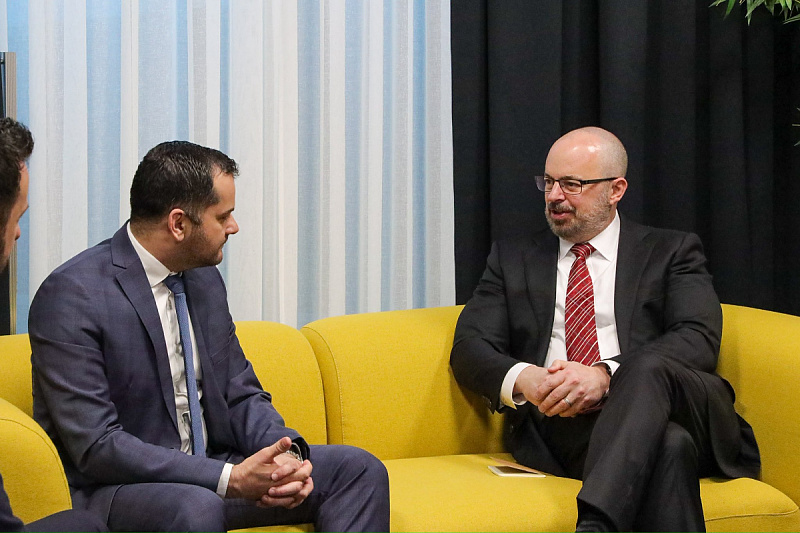
As announced by the U.S. Embassy in Bosnia and Herzegovina, Chargé d’Affaires John Ginkel met with the General Director of Mostar International Airport, Marko Đuzel. The main topic of discussion was the possibility of American investment and partnership that would transform the outlook of this Herzegovinian airport in the long term.
"More jobs, increased tourism, and better regional connectivity—these are the opportunities that American investment can bring to Mostar International Airport," stated the U.S. Embassy.
What does the American plan for Mostar entail?
During the meeting, it was discussed in detail how the American side could concretely contribute to the airport's development. The focus of potential cooperation was placed on physically expanding existing capacities with the help of American expertise and resources, as well as on a thorough modernization of infrastructure through the procurement of new equipment and the upgrading of facilities.
The ultimate goal of these investments, as highlighted, is to transform Mostar Airport into a modern service and logistics hub that would serve not only Bosnia and Herzegovina but the entire region with its capacities.
The realization of these plans would bring more direct flights to European destinations. This, the Embassy emphasized, would significantly facilitate travelers in discovering the tourism potential of Herzegovina, while also strengthening ties between Bosnia and Herzegovina and the United States.
Expanding American Economic Influence in the Federation of Bosnia and Herzegovina
The announcement of potential investment in Mostar Airport comes at a time when the United States is actively strengthening its economic presence in Bosnia and Herzegovina.
Recall that the U.S. Embassy recently welcomed with great enthusiasm the adoption of amendments to the Southern Interconnection Gas Pipeline Law in the House of Representatives of the FBiH Parliament. This law opened the door for the American investor, AAFS Infrastructure and Energy d.o.o., to take over the gas pipeline from the domestic "BH Gas," which the Embassy called a "fantastic day for energy security in BiH" and a new era of economic development.
Ginkel also visited the Aluminij company yesterday, where he discussed the importance of the Southern Interconnection with Amir Gross Kabirija. On that occasion, the U.S. Embassy emphasized that access to American LNG gas would ensure a stable energy source necessary for economic growth, calling this project a trigger for the "industrial revival" of Herzegovina.
While the entry of American capital into the energy sector through the Southern Interconnection has faced some criticism from civil society, potential investment in Mostar Airport could receive much broader public approval.
Mostar Airport has been struggling for years to establish a stable flight schedule and utilize its full potential, and the entry of a serious American partner could be exactly the tailwind it needs to become a serious competitor to airports in Sarajevo and neighboring Dubrovnik.