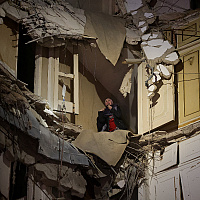
On Wednesday afternoon, at least five consecutive strikes rocked the capital city of Beirut as the Israeli military announced it had launched the largest coordinated attack of the war. Most of the assaults occurred in civilian-populated areas.
A total of 254 people were killed and over 1,100 injured across Lebanon, according to the country's civil defense service. The highest number of casualties was recorded in Beirut, where 91 people were killed.
The strikes raised questions about ceasefire efforts in the Middle East, with Iranian President Masoud Pezeshkian stating that a ceasefire in Lebanon is a crucial condition for his country's agreement with the United States.
This marked the deadliest day of the war in Lebanon, which erupted on March 2 when Hezbollah attacked Israel in support of Tehran following a U.S.-Israeli strike on Iran two days earlier. In response, Israel launched a comprehensive air and ground offensive.
Early on Thursday, Hezbollah announced it had retaliated against Israel, citing a violation of the ceasefire.
"This response will continue until the Israeli-American aggression against our country and our people ceases," the group stated in a release.
One of the largest medical centers in Beirut announced it needs donations of all blood types.
"The scale of killing and destruction in Lebanon today is nothing short of horrific. Such a massacre, within hours of agreeing to a ceasefire with Iran, defies belief," said UN human rights chief Volker Turk.
Additionally, late Wednesday evening, another attack targeted the southern suburbs of Beirut.
In a televised address on Wednesday evening, Israeli Prime Minister Benjamin Netanyahu stated that Lebanon is not part of the ceasefire with Iran and that the Israeli military continues to forcefully attack Hezbollah.
White House spokeswoman Karoline Leavitt and Vice President JD Vance also said on Wednesday that Lebanon is not included in the ceasefire.
"I think this stems from a legitimate misunderstanding. I believe the Iranians thought the ceasefire included Lebanon, and it simply does not," Vance told reporters in Budapest.
Earlier, Pakistani Prime Minister Shehbaz Sharif, a key mediator in the ceasefire negotiations between the U.S. and Iran, had said the ceasefire would include Lebanon and that Hezbollah had halted attacks.
The Iranian Revolutionary Guard warned the U.S. and Israel that it would deliver a "response that will cause regret" if attacks on Lebanon do not stop. Lebanese President Joseph Aoun condemned Wednesday's attacks and said French President Emmanuel Macron told him he is prepared to exert diplomatic pressure to include Lebanon in any ceasefire.