Sixty-five years ago today, the vision of Soviet scientist and inventor Konstantin Tsiolkovsky was fulfilled. In the 19th century, he wrote: "The human race will not remain on Earth forever, but in the pursuit of light and space will first timidly emerge beyond the atmosphere, and then will conquer the entire expanse of the Solar System." As if quoting Tsiolkovsky, the Soviet space and rocket program of the 1960s, with the arrival of the technocratic echelon of Soviet leaders led by Nikita Sergeyevich Khrushchev, gradually began the phased conquest of space.
After the first artificial satellite, Sputnik-1, which gave the Soviet side a powerful advantage at the outset of the Cold War space race, the plan was to launch and return a human to Earth, who would begin a new era of space travel. In the Sputnik-2 mission, following the successful flight of the dog Laika into space, valuable experience was gained on how living beings cope with the stresses of spaceflight. After Laika, the dogs Strelka and Belka also underwent space adventures, after which the construction of the spacecraft that would carry the first human into space from Earth's east began.
Such a feat required the best the USSR had in every segment, which is why the construction of the Vostok-1 spacecraft was undertaken by the most famous rocket expert, Sergei Korolev. However, regardless of the quality of all components of the first spacecraft for human flight, the decisive factor was the cosmonaut who would embark on a journey full of uncertainty.
The son of a carpenter, a foundry worker by trade, Yuri Gagarin was born on March 9, 1934, in the village of Klushino into a poor family whose members worked in the local collective farm. From his boyhood days, marked by war and the invasion of the German army, young Yuri nurtured a dream of becoming a military pilot. However, difficult living conditions forced Gagarin to gain experience in aeroclubs before entering the military academy, while working as a foundry worker.
After lengthy training, strict selection, and careful adherence to personnel and party policies, Gagarin was chosen as the first Soviet cosmonaut to fly into space. During the selection of the first Soviet cosmonauts, numerous factors worked in Gagarin's favor. As a test pilot of jet aircraft, he had accumulated a large number of flight hours, and his height and body mass fully matched the plans of the designers of the Soviet space program. Nevertheless, part of the expert public notes that his friend Gherman Titov was a better pilot and a better option for the first spaceflight, but Gagarin's class origin was decisive.
Thus, all conditions were ensured for the first human in space to be someone with whom all workers of the world could identify, which was an indispensable segment in the conditions of the propaganda war between East and West.
Instead of a countdown, "Let's go"
After demanding tests of all abilities necessary during the spaceflight, Gagarin entered the final phase of familiarization with the Vostok-1 spacecraft. After dawn on April 12, 1961, Gagarin, accompanied by his friend Gherman Titov, who would serve as the backup pilot, left the Kosmonaut Hotel for the bus that would take him to the Baikonur Cosmodrome.
However, on that occasion, Gagarin felt the need to urinate during the ride to his rocket. Knowing that his spacesuit would soon be fastened and that his next opportunity to urinate would be only after several hours, he decided to stop the bus and call all male crew members. After "relieving themselves" on the front right tire of the bus, Gagarin and all crew members boarded the bus. In his memoirs "Road to the Stars," Gagarin described the last moments before arriving at the cosmodrome: "From afar, I saw the silver body of the rocket pointing upward, which had six engines with a total of 20 million horsepower. The closer we got to the launch platform, the larger the rocket appeared, as if growing. It resembled a giant lighthouse, and the first ray of the rising sun shone on its sharp tip," wrote Gagarin.
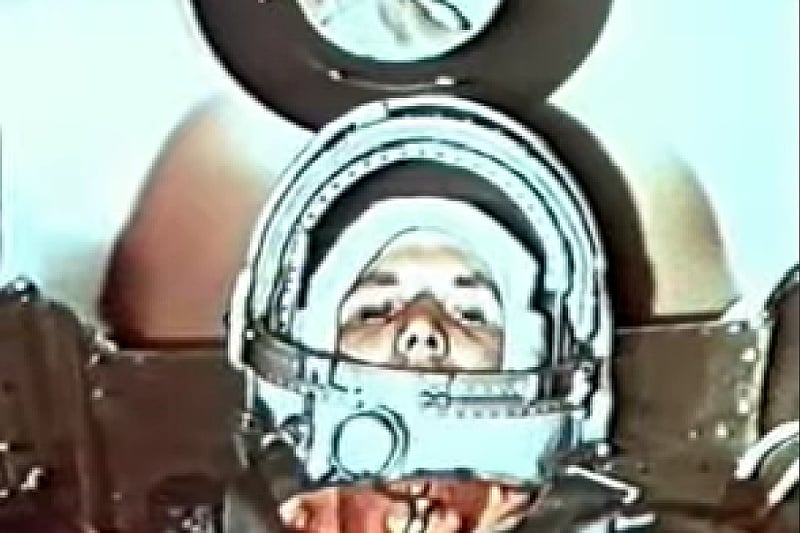
After greeting the chief designer, Gagarin entered the spacecraft, which was equipped with a TV camera and microphones to maintain constant communication with Earth and the crew at the cosmodrome.
Exactly at 9:07 Moscow time, after the command "Liftoff" instead of a countdown, Gagarin said "Let's go," after which the powerful engines of the R-7 Semyorka rocket separated Vostok-1 from Earth.
Describing how he experienced Earth after the most intense pressures the spaceflight exerted on his body, Gagarin wrote: "Earth delighted me with a lush palette of colors. It is surrounded by a halo of delicate blue." Speaking about the flight at a speed of 28,000 kilometers per hour, Gagarin emphasized that a major problem for him was not being able to open his mouth wide while consuming specially prepared food.
At precisely the designated moment after the flight around Earth, which lasted one hour and 48 minutes, the automatic braking and guidance system gradually returned Gagarin to the USSR. A special moment for Gagarin occurred after landing when local farmers mistook him for an enemy paratrooper.
After a brief confusion among the peasants in whose meadow the first Soviet cosmonaut had "fallen" from space, news spread across the USSR and the world that Yuri Gagarin, the Soviet cosmonaut, was the first human to go and return from space.
After the exhausting flight, Gagarin would be awarded the Order of Hero of the Soviet Union and promoted to the rank of colonel. However, his illustrious career as a test pilot would tragically end on May 27, 1968.
Nevertheless, the real consequences of Gagarin's flight are best seen in the speech of U.S. President John F. Kennedy, who just 40 days later announced the start of the American Apollo program, with the goal of having a human foot step on the Moon.