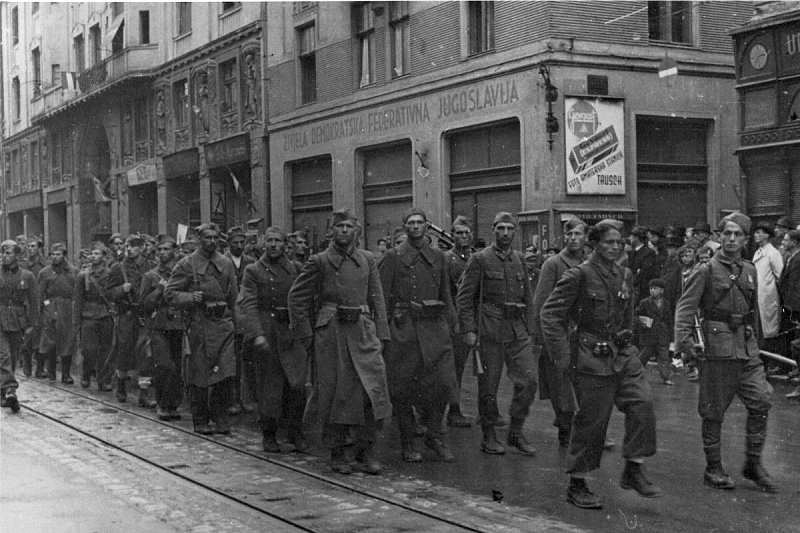
Following successful operations to liberate occupied territories in early 1945 in the area of Bosnia and Herzegovina, the forces of the Yugoslav Army (JA) had been planning an operation since March aimed at liberating Sarajevo.
From February to March, JA forces held Ustasha, Domobran, and German troops in a semi-encirclement in Sarajevo and its wider surroundings, while partisan underground operatives worked to seize key and vital facilities as part of preparations for the city's liberation.
Allied bombers strongly supported the war operations of partisan units, destroying in massive attacks the remaining supplies of German forces that planned to withdraw from the city.
At the start of the "Sarajevo Operation," the Germans, together with collaborationist forces for the city's defense, had approximately 38,000 soldiers, while the JA forces engaged seven divisions. The attack by partisan forces began on March 28, accompanied by heavy artillery fire.
In the "Sarajevo Operation," JA forces advanced toward the city from several directions, with the primary focus being a breakthrough via Ivan Sedlo. On this front, JA forces achieved minor successes during attempts to advance toward Tarčin and Pazarić.
On other fronts, forces from Vareš, Podromanija, and Pale managed to capture key heights by early April, creating conditions for an attack on the city from which German forces gradually and systematically began withdrawing in early April.
After the decision to withdraw the bulk of German forces from the tightening encirclement around Sarajevo, the Ustasha planned to destroy the power plant on April 3, an action opposed by a group of underground fighters led by national hero Vladimir Perić - Valter.
On April 4, JA forces penetrated the city from several directions, pushing out Wehrmacht troops supported by collaborators. However, in battles at Marijin Dvor, remnants of the German army's 334th Regiment put up strong resistance against the liberators.
Sporadic fighting in the city continued on April 5, although partisan forces had taken control of almost all the most important heights and facilities around the city.
Victoriously entering the city around 4 p.m. on April 5, the 16th Muslim Brigade of NOVJ descended through the Vratnik Gate, aiming to liberate the core of the Old Town and the City Hall.
After the remnants of units that broke through the encirclement around the city withdrew, from the early morning hours of April 6, 1945, Sarajevo was liberated.
In the anti-fascist struggle from 1941 to 1945, 10,961 citizens of Sarajevo lost their lives, and during the "Sarajevo Operation," JA forces suffered 637 killed, 2,020 wounded, and 27 missing fighters. With the liberation of the city, one of the darkest chapters in the history of the capital of Bosnia and Herzegovina came to an end, a city that successfully survived Nazi occupation and welcomed liberation from occupiers and domestic collaborators.