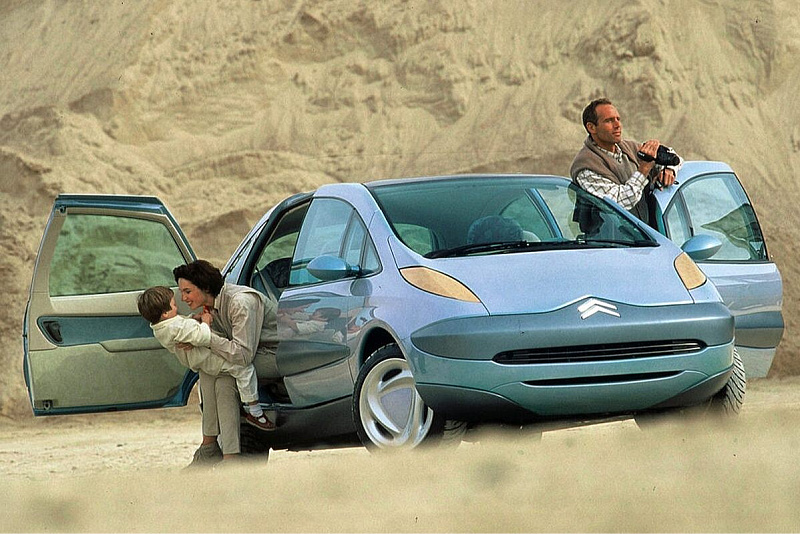
On the driver's side, one door; on the passenger side, two doors without a B-pillar between them, a panoramic windshield extending to the roof, rotating front seats, a flat dashboard free for placing objects, and an asymmetrical steering wheel in front of the instrument panel.
The Xanae concept was not a design provocation. It was an answer to a question the rest of the industry had not yet even asked: "What if a car becomes an extension of the home?"
Unlike many concept cars that are essentially "polished" pre-production vehicles, Xanae was a true laboratory of ideas. Fully functional, hand-built, and intended exclusively for the Paris Motor Show.
Behind it stood a team led by Dan Abramson, hired by Citroën's design chief Arthur Blakeslee. Mark Lloyd designed the exterior, Marc Pinson the interior, and the result was a car that, according to contemporaries, combined the genes of a sedan with the spaciousness of a luxury vehicle, all within a length of 4.20 meters.
The idea did not remain just on paper. Luc Epron, who headed Citroën's marketing and development department, fought for a series interpretation of the concept, and it was born in 1999 as the Xsara Picasso, one of the symbols of compact MPVs in Europe. True, the then CEO of the PSA Group, Jacques Calvet, did not have much faith in the project and approved a modest budget. The Xsara Picasso nevertheless became a hit.
Thirty years later, Citroën has once again exhibited Xanae. This time at Rétromobile 2026 in Paris, alongside five other legendary concept cars. The lesson is clear: some visions simply do not age.