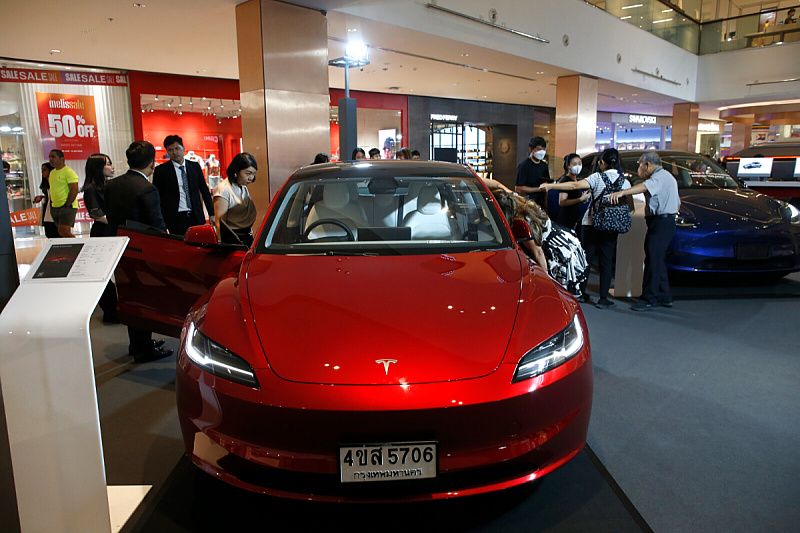
Whether you're a passionate electric vehicle enthusiast or a skeptic, it's hard to deny the impact of the Model 3 on the global battery vehicle market. The car was first introduced in late March 2016 as Tesla's third mass-produced model, following the luxury Model S and the Model X SUV. It was intended as a "more affordable" version, aiming to bring electric mobility to a broader audience.
Over 325,000 Reservations Right from the start, the Model 3 demonstrated the power of the Tesla brand and Elon Musk in generating mass interest, as reservations poured in immediately. In fact, within just a few days, over 325,000 reservations were recorded, allowing the American electric sedan to surpass the previous record set by the Citroën DS in 1955, for which the French received only 80,000 reservations.
The idea of an affordable Tesla actually developed much earlier. As far back as 2006, Elon Musk spoke in interviews about his ambition to create an electric car that most customers could afford, with a planned price of around $30,000. Initially, the car was supposed to be named the Model E, but the name was already registered and taken (Mercedes E-Class), so Model 3 was chosen instead.
The first Model 3 units reached customers in the second half of 2017, in a rear-wheel-drive version with a 75 kWh battery that offered a range of about 500 km. Other variants were later launched, including the most affordable version with a 50 kWh battery and a range of around 350 km. The model quickly became a symbol of minimalist design: a smooth front grille without the classic grille, a simple interior, and a central screen controlling most functions.
The Model 3 very quickly confirmed its market dominance. In 2018, it became the world's best-selling electric car, and by early 2020, Tesla surpassed the Nissan Leaf's record, selling over 800,000 units that year. Over the years, the Model 3 has also won numerous awards, including "Car of the Year" titles in several European countries.
Constant Updates and No. 1 in Bosnia and Herzegovina However, success did not come without challenges. Initially, the Model 3 faced criticism for build quality issues and technical shortcomings, such as a longer braking distance compared to some traditional vehicles. As with its previous models, Tesla continuously addressed these issues through production runs.
Today, ten years after its introduction, the Tesla Model 3 is still considered a key model in the global electrification of automobiles, proving that an electric car can be widely accepted, practical, and commercially successful.
The Model 3 is also the most represented on Bosnian roads. Its affordable price combined with above-average performance is what attracts local drivers the most. Over 40 Model 3 units are registered in Bosnia and Herzegovina. While a symbolic figure, it dominates over other Tesla models and other brands in the overall modest electric vehicle market.