Although he has already won over audiences in the capital of Bosnia and Herzegovina through various performances, the concert on April 24 will actually be his first solo concert in the capital of Bosnia and Herzegovina. The two concerts are a result of great interest, but also the desire to create a special, direct relationship with the audience in an intimate space like the BKC. In an interview for Klix.ba, he reveals what performing in Sarajevo means to him, how he views his career today, and why he increasingly trusts intuition and less calculation. "We opened the first one on the 24th, and when we saw it was going well, the second date followed; people here probably also longed for concerts and good music. I feel that generally there is some space that has been created for concert stories. Not just for me, but also for colleagues, and that's a beautiful thing happening. There are fewer of those discotheques that were popular, where people waited in lines outside, and more concerts where people can sit and enjoy the music," Selimović tells us at the beginning of the conversation. Considering that he is coming to Sarajevo after holding a concert at the Sava Center in Belgrade, Selimović notes: "For example, yesterday we talked about how Sarajevo lacks a hall like the Sava Center that can accommodate 1,500 to 2,000 people. That should be discussed." "These are more intimate spaces, and in my opinion, the most beautiful concerts are in such spaces. I think my older colleagues would say the same. I recently met Zdravko Čolić at a rehearsal, and he says: 'If I could, I would only do venues like the Sava Center.' It's easier to connect with the audience than when there are 10,000 or 20,000 people. Concerts with such audience numbers are mostly held in spaces intended for sports matches; they don't have such good acoustics. Plus, you have the feeling that you are together in a room," he adds further. The story that the audience in Sarajevo is the most demanding is "nonsense"; you simply have greater responsibility. Commenting on why the solo concert didn't happen earlier, he tells us: "It's not my fault as much as it was due to technical reasons. Why couldn't it happen earlier—we couldn't get a date. Then we looked at which venue suits me, and the decision fell on BKC. Maybe the next step could be Skenderija." "Whenever I came to Sarajevo, I always had a dose of stage fright. I wondered why that is, and I don't feel it when, for example, I sing in Mostar. Probably because Sarajevo was the center of pop-rock music, culture; here originated Nadrealisti, Indexi, Čola—a whole scene that influenced me. Now imagine how important it is to me that what I do, since I'm doing it here, is good. That's why I had some weight. There are people who, when they come to Sarajevo, talk about how it's the best in Sarajevo," he adds further. On the cliché that the audience in Sarajevo is "the most demanding," he joked: "That's 'nonsense'," then clarifies, "Simply, many started from Sarajevo, so you have greater responsibility, and here the audience is accustomed to good notes. The audience in Sarajevo is the same as in Mostar, Skopje, Zagreb; I don't understand this division of audiences." Selimović began his career in the competition "Zvijezda možeš biti ti," followed by the music competition "Zvezde granda," which he won in 2014. Reflecting on his career and beginnings, he says: "Maybe I calculated more back then; now I calculate less in what I do. I fight with quality and good songs." After a series of duets with colleagues, a collaboration with Dženan Lončarević is coming soon. At the very beginning of his career, he was compared to numerous stars, especially Zdravko Čolić, and Selimović says that all those role models shaped him. "There is influence, not just from Čola, but from many people who created that Sarajevo pop-rock school and pop music in general, from Kemal Monteno, through Indexi to Dino Merlin, and I took from each what I needed. It's best for a person to have their own color, expression, and direction. That was difficult at the beginning because I was compared to people whose songs I sang. From this point of view, everything was supposed to be that way, and I think with the song 'Imaš me,' I somehow found my direction," he states. Selimović recently released the song "Da neko pita," written by Đorđe Balašević's daughter, Beba Balašević, at only 16 years old. Through the conversation, he revealed how it came into his hands. "I recently asked her how it's possible that no one from 2002 recorded that song. I even heard a demo version by Đorđe Balašević with some text that he changed, and I wondered how. She said it simply didn't happen and she didn't want to give that song to anyone. Maybe I heard it sometime earlier, and then we had coffee in Novi Sad, and she told me: 'Well, you could sing it.' From the moment we had coffee until the song was released, two months passed. It's great that such a thing from such a family came into my hands," he admits. He also revealed that he plans a duet with Dženan Lončarević, which should be released soon. "We've been arranging a duet for about seven years, and at one point, a friend of mine who isn't from the music world at all said: 'I'll call Dejan Kostić to make a song for you.' I thought he was joking, and the other day they called and asked if I wanted to hear the song. I heard the song Dejan made, we both liked it, and I think it will be released in the next few months," he adds. Speaking about desired collaborations in the future, he says: "I've always mentioned Dino Merlin as an unfulfilled wish; recently I've talked with Dženan Lončarević and Džejla Ramović, so we'll see if it happens. I'm not at all burdened by whether someone is a bigger or smaller star; if the song is good, I'll record it—that's the only rule." We have a famous saying: "When will? When will the wedding? When will college? When will children?" Selimović also commented on the phenomenon of Jakov Jozinović, who sells out halls in the region, and says he deserves respect for what he has done. "It's completely clear to me how all that happened. It is some phenomenon, and now people analyze it, but it's just proof that people are eager for good music, emotion. He, at least in my opinion, has brought that 'older' pop music closer to younger generations who weren't even born—when I started my career, Jakov was 5 years old," he states. He added: "When he has his own 20 songs, let him sing them. Currently, he doesn't have them. He did something no one else managed, and that deserves respect. Why does it bother anyone that a young man sings? I don't understand analyzing these things, with so many life problems—here, fuel goes to 4 KM—that's a problem, not Jakov Jozinović and his concerts." Throughout his career, Selimović has tried to hide his private life from the public eye, saying that "if you don't give something on a platter, no one will find out." "There's a famous question here: 'When will?' Here people generally ask: 'When will this? When will that? When will you get married? When will college?' When I finished school, it was: 'When will college, when will you get married?' I mean, if I got married tomorrow, it would immediately be: 'When will children?' Because of that 'when will,' I decided everything goes step by step; I arrange my own world at my own pace. Everything can, and nothing must, because only that way can you stay normal in all this. I think you should keep your happiness to yourself," he concludes. Finally, he shared what he hopes for from the concerts on April 24 and 25: "It will be a beautiful evening. There will be an expanded lineup, despite it being a smaller stage. I wanted it to sound rich, to have something to offer; there will also be some surprise guests. There will be good songs, beautiful energy, emotion, and I want everyone to leave happy, satisfied, and full of impressions."
Society
Mirza Selimović: The claim that the Sarajevo audience is the toughest is "completely off base"; here it's famously: "When are you getting married?"
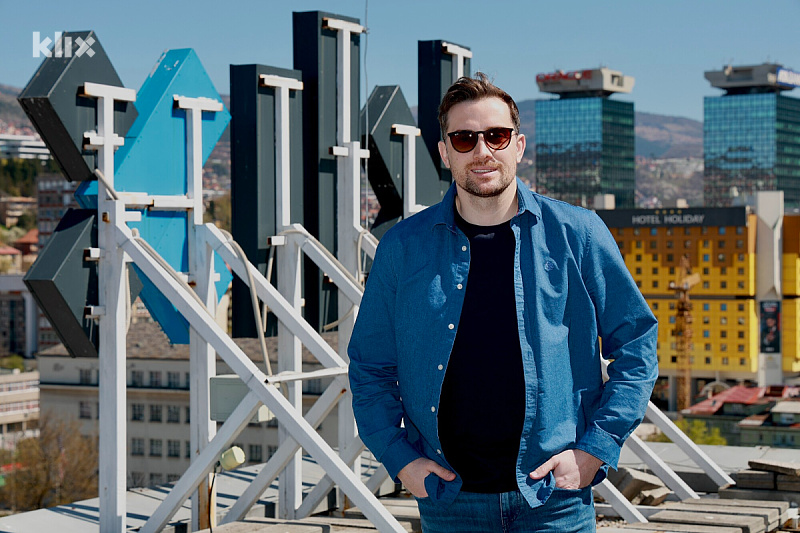
At a time when concerts are regaining significance, Mirza Selimović has announced two performances at the Bosnian Cultural Center (BKC) in Sarajevo. They will take place on April 24th and 25th, and he spoke to Klix.ba about expectations ahead of the shows, new songs, plans, and his personal journey through his career.
ingestion