Everything changed when he was 13 years old. A family friend and nanny came to his home in Newton, Massachusetts, and handed him a folder full of accessible instructions for assembling a Middle Eastern palace. The instructions, written in Braille, enabled him to complete the set without relying on the colorful pictures that typically come with Lego sets.
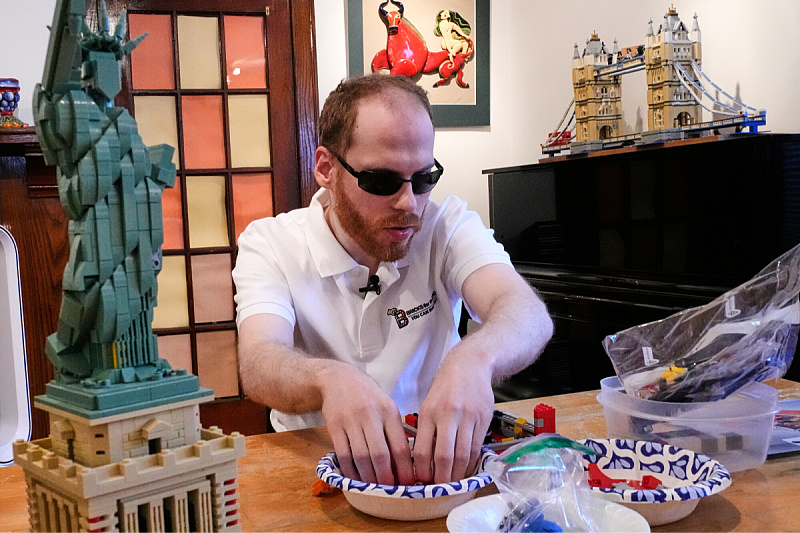
"This was the first time I was able to independently assemble a Lego set," said Shifrin in his home, surrounded by sets he has built, including a Statue of Liberty figure and NASA's Apollo Saturn V rocket. "It was truly an incredible experience because I was in complete control of the entire assembly process. I knew where each piece went and could learn about the world around me along the way."
After his nanny passed away, Shifrin wanted to honor her memory. So, he began refining the instructions the two of them had already posted online, to make them available to other blind builders.
Three years ago, Shifrin launched Bricks for the Blind. Today, as a 28-year-old, he collaborates with a team of 30 sighted and blind testers. On his website, instructions can be downloaded for free in digital format for anyone who is blind or visually impaired. They can be printed in Braille, used with Braille computers, or accessed through screen readers, software that converts text to speech.
The instructions allow a blind person to assemble a set independently, but Shifrin's website notes that a sighted person might be needed to sort the Lego bricks. Alternatively, a blind builder can use one of several apps that use artificial intelligence to recognize the bricks.
So far, this nonprofit organization has created instructions for over 540 Lego sets, ranging from 100-piece cars to 4,000-piece bridges. Their instructions have been used by about 3,000 builders across the United States and as far away as Australia.
In 2017, Shifrin also approached the Danish company Lego Group with a proposal to make their products more accessible. This inspired the company to introduce audio and Braille instructions for an increasing number of Lego sets, launched in 2019.
Independently, the company also introduced Lego Braille Bricks in 2020, available in French, English, and Spanish, with raised bumps corresponding to letters, numbers, and symbols. Lego has also included several visually impaired characters in its sets.
Shifrin, who is also an actor, composer, and opera singer, says he has received numerous messages from people who previously couldn't assemble Lego.
Blind grandparents have reached out to him, saying they can now build sets with their grandchildren. "We couldn't build with our children. They didn't want our help, but now we can teach our grandchildren about Lego," Shifrin relayed. "Or blind parents who say: 'My children are sighted, they don't want my help, but it's amazing to finally understand what all this Lego fuss is about, because now I can build on my own.'"
Daniel Millan, who lost his sight in 2024, turned to the Bricks for the Blind platform after a tumor pressed on his optic nerves. This 31-year-old master's student from San Diego, training to become an assistive technology instructor, first assembled a Lego ornament set. Then, on his wedding anniversary, he built a Lego rose set with his wife.
"The ability to do this independently means freedom," he said, adding that after suddenly losing his sight, he wondered what he would no longer be able to do.
But after assembling Lego sets, he quickly realized that "it's not about what I can't do anymore, but about what I can do," as he put it.
For Natalie Charbonneau, who is blind, the instructions meant she could complete sets without relying on her sighted husband. They also allowed her to have fun with her five-year-old son—building numerous fire trucks and other vehicles.
"If he has questions, I now have the ability to check his work or follow along, instead of saying: 'You have to wait for Dad' or 'You have to ask Dad.' This is something I can now do with him, which is empowering," she said. Charbonneau, who tests instructions for Bricks for the Blind, is a doctoral student living in Bellingham, Washington.
Teri Turgeon, director of community educational programs at the Perkins School for the Blind in Watertown, Massachusetts, the school Shifrin attended as an infant, says accessible instructions allow blind children to experience the same joy as their sighted peers. It also helps them visualize the wider world and develop "fine motor and tactile skills."
"He created a space for innovation and accessibility that didn't exist before, and he did it using a toy that children play with every day," she emphasized.
In his home, Shifrin also helped fellow builder Minh Ha, who is also blind, assemble a go-kart vehicle. Ha reached for Lego bricks and elements from two containers and first began assembling the driver figure.
"Just the legs, torso, head, helmet. You've built this before. Piece of cake. I believe in you," Shifrin told her.
"Awesome," she replied with a smile. "Okay, now I'll put the helmet on the head. And then... put the legs on the body."
She recalled her journey, which began two years ago when she built a lotus flower.
"Many blind people have been excluded from this cultural, almost childhood phenomenon of building and playing with Lego," said Ha. "It's incredibly satisfying and simultaneously relaxing to assemble these very complex, beautifully designed, and architecturally intricate sets."