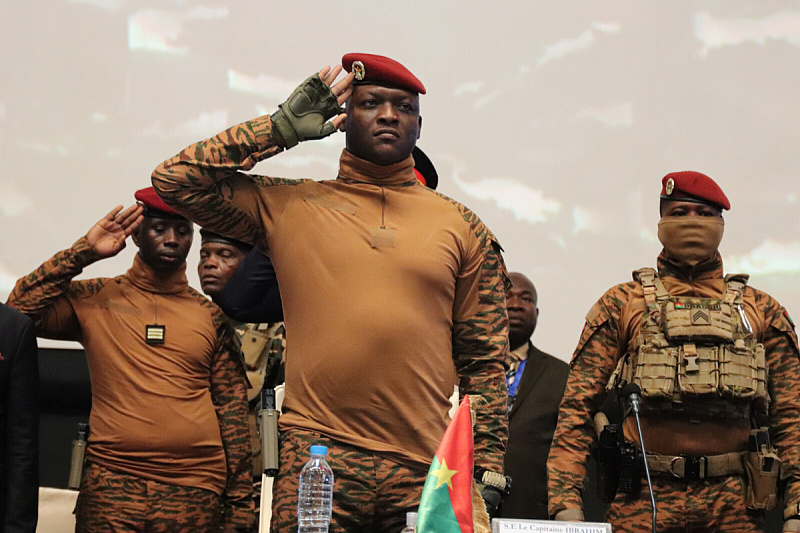
Traoré came to power in a coup in September 2022, ousting a second military government that had taken control just nine months earlier. Since then, he has suppressed the opposition, and in January, he completely banned political parties.
A transition to democracy was initially planned for 2024, but that year, the junta extended Traoré's term until 2029.
"We don't even talk about elections. People need to forget about the question of democracy. We must tell the truth: democracy is not for us," Traoré said in an interview with state broadcaster Radiodiffusion Télévision du Burkina (RTB).
Democracy is a "lie," he added, giving his interpretation of this political system.
"Democracy—we kill children. Democracy—we drop bombs, kill women, destroy hospitals, kill civilians. Is that democracy?" Traoré stated.
Traoré has gained supporters across Africa with his anti-French and anti-Western rhetoric, often invoking the legacy of Burkina Faso's revolutionary leader, Thomas Sankara. Sankara was the president of Burkina Faso, which he renamed from Upper Volta, from 1983 until his assassination in 1987.
However, Traoré has failed to stop the insurgency that since 2014 has claimed thousands of lives and displaced 2.1 million people, nearly nine percent of the population, according to the latest official data published three years ago.
More than 1,800 civilians have been killed since 2023 by the army, allied militias, and the group Jama’at Nusrat al‑Islam wa al‑Muslimin (JNIM), Human Rights Watch (HRW) reported.
The organization accused all parties of crimes against humanity and war crimes. It claimed that the junta and allied militias ethnically cleansed civilians of the Fulani people, whom they accused of supporting JNIM, carried out targeted killings, and forcibly displaced communities.
In April 2024, HRW accused the army of executing 223 civilians in a single day two months earlier. The government denied this and banned HRW's work, as well as several international media outlets that reported on it.