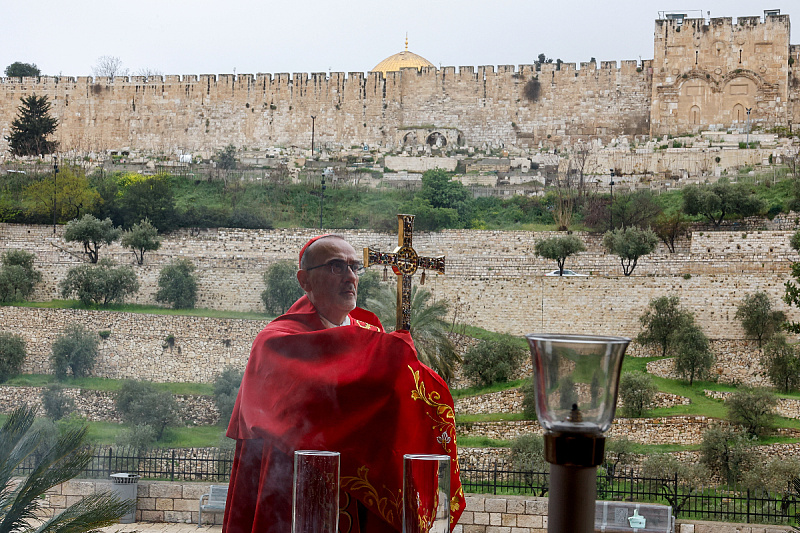
Believers and local residents are calling on church leaders to resist increasing Israeli control, harassment, and strict restrictions on access to holy sites. The restrictions imposed during the war with Iran have further heightened tensions in Jerusalem's Old City. Palestinian Christians emphasize that the limitations on access to religious sites are not merely temporary measures but reflect deeper patterns of control and growing pressure on religious communities. On Palm Sunday, Israeli forces stopped Cardinal Pierbattista Pizzaballa, preventing him from entering the Church of the Holy Sepulchre. Church officials described this incident as the first disruption of its kind in several centuries. After being denied passage, Pizzaballa led a mass outside the Old City, with Israeli authorities only granting him access to the church later. However, the local population's reaction to his move was harsh. "He should have found a way to enter," stated one local merchant, adding, "If necessary, he should have prayed right on the street."
Security Concerns or Systematic Control? Israeli police justified the restrictions by citing rocket threats related to the war against Iran, pointing to the danger of shrapnel in Jerusalem. Nevertheless, Palestinians argue that the restrictions extend far beyond mere security concerns. As evidence, they cite recent closures and blockades of access to the Al-Aqsa Mosque during Ramadan and Eid. East Jerusalem has been under Israeli control since 1967, a status considered illegal under international law. Critics note that restrictions on movement and prayer, especially during religious holidays, serve solely to consolidate this control. At the same time, observers point to double standards, noting that Jewish celebrations in other parts of the city during the same period proceeded without any hindrance.
Rise in Attacks and Vandalism In addition to current blockades, Christian leaders warn of a documented increase in attacks on their community. According to reports from the Rossing Center for Education and Dialogue, 111 incidents were recorded in 2024 alone, including 47 physical attacks and 35 cases of vandalism targeting churches and clergy. Incidents are becoming commonplace, including constant spitting on priests along the Via Dolorosa. A shocking report noted that one Armenian priest reported being spat on more than 90 times in a single year. Targets of attacks and damage have included the Church of the Flagellation and the cemetery on Mount Zion, while critics argue that the response from authorities is inconsistent and incidents are often covered up. The International Center for Justice for Palestinians (ICJP) warned that denying access to the Church of the Holy Sepulchre constitutes a "flagrant act of religious persecution," linking it to broader pressures on Muslim and Christian guardians of holy sites.
The situation is no better in the occupied West Bank. Pressures extend beyond access restrictions alone. Reports detail brutal attacks on Christian communities, including arson near the Church of St. George in Taybeh, the destruction of olive trees, and intimidation leading to the displacement of families. Data from human rights groups from December 2023 to February 2024 indicates patterns of violence that, while often linked to property disputes, are a direct result of movement restrictions and activities by Israeli settlers affecting Palestinian Christians. Church leaders from multiple denominations warn that such conditions, combined with a complete lack of accountability for attackers, threaten to accelerate displacement and permanently erase the historical presence of Christians in the region.
During Easter week, residents described the Old City as a "ghost town," despite it being a period that typically attracts tens of thousands of pilgrims and tourists. "There are no celebrations. At this time of year, the city should be bustling," said one resident. Instead of pilgrims, the daily reality around the Church of the Holy Sepulchre is now dictated by heavy security forces, checkpoints, patrols, and barriers.