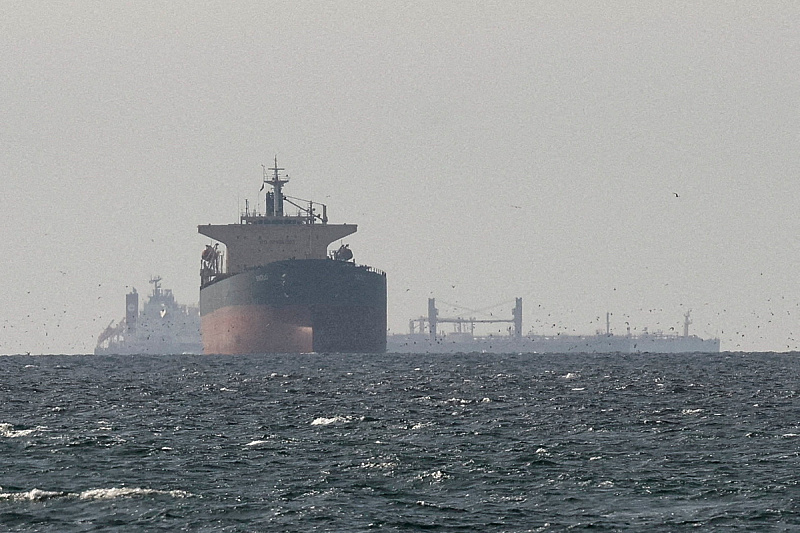
Iranian state media report that the Strait of Hormuz remains closed following continued Israeli attacks on Iranian allies in Lebanon. Two Iranian media outlets published data from a vessel tracking website showing a Panama-flagged ship approaching the strait before turning back, with the caption: "The Strait of Hormuz is completely closed, forcing oil tankers to return." White House spokesperson Karoline Leavitt told reporters at a briefing that all reports suggesting the strait is closed are false and that there has been an "increase" in the number of ships passing through it. Leavitt added that Trump is aware of these "unacceptable" false reports and has received assurances from U.S. officials that the passage is indeed open. Meanwhile, commercial shipping broker SSY confirmed to BBC Verify that ships in the Gulf received a message from the IRGC stating: "The Strait of Hormuz remains closed, and permission from the Revolutionary Guard is required to pass through this route. Any ship attempting to enter the strait without permission will be targeted and destroyed." "Ships planning to pass through the Strait of Hormuz should choose alternative routes to 'fulfill the principles of maritime safety and be protected from possible collisions with sea mines,'" according to a statement from the Iranian Revolutionary Guard cited by Iranian state media, as reported by the BBC. The statement further lists alternative routes, along with a map illustrating them. Ships entering from the Sea of Oman should sail north of Larak Island and then continue toward the Persian Gulf. Ships sailing in the opposite direction should exit the Persian Gulf, pass south of Larak Island, and continue toward the Sea of Oman. Due to renewed tensions, oil prices have risen slightly, by about three percent, compared to yesterday when an agreement on a two-week ceasefire was announced. However, it remains below $100 per barrel, hovering around $97. The Strait of Hormuz, a narrow shipping route in the Persian Gulf region, is one of the world's most important shipping lanes and a point of contention in the conflict. U.S. President Donald Trump has repeatedly threatened to attack Iranian civilian infrastructure if the blockade of the global shipping channel is not lifted, and an agreement to reopen the passage through the strait was reached on Tuesday evening as part of a two-week ceasefire between the U.S. and Iran. However, Iran warned on Wednesday that ships passing through the strait without permission from the Revolutionary Guard "will be targeted and destroyed."
Society
How open is the Strait of Hormuz really? Oil prices have risen slightly again.
Due to ambiguities and the non-compliance with the ceasefire reached by Washington and Tehran, the Strait of Hormuz appears to be closed again to all ships without passage approval from the Iranian Revolutionary Guard.
ingestion