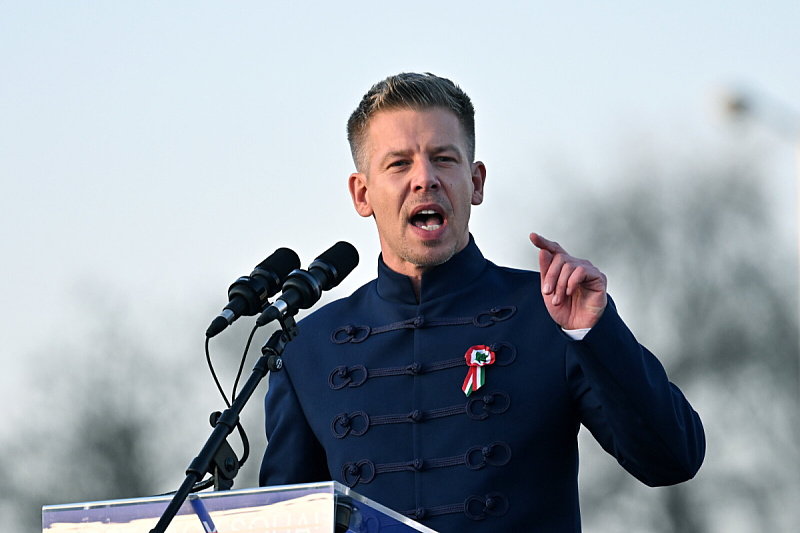
Magyar revealed the information about the Orbán poster in his room in a podcast, and Orbán, then a leading figure in the pro-democracy movement in the country, was just one of the posters that adorned his childhood room. Few could have predicted Magyar's meteoric rise and that of his party, Tisza. "He built an opposition movement at an incredible speed. Never in the history of post-transition Hungary have we seen a party grow so quickly," said Gábor Győri from Policy Solutions, a Budapest-based political research institute. Conversations with people who know Magyar often oscillate between admiration and antipathy. Many praise the massive movement he built and the discipline he showed while touring the country, giving up to six speeches a day, but simultaneously describe him as short-tempered and sometimes rough in style. Others see him as the perfect man for the moment. "I think he, like all politicians, can be a difficult person at times," said director Tamás Topolánszky, who was part of the team that followed Magyar for the past 18 months for a film about the broader changes shaking Hungarian society. Topolánszky described Magyar as authentic and passionate, but also as someone who can be impatient. "I think we Hungarians have now realized that this was necessary to get to this point," he said. Through his lens, Topolánszky followed Magyar as he began visiting villages and towns across Hungary, gradually breaking the apathy that long characterized Hungarian politics. "The energy at those rallies was something I had never experienced before," he said. Magyar's unique ascent is further influenced by his deep ties to Orbán's party, Fidesz. He spent much of his life moving in its elite circles. Among his close friends was Gergely Gulyás, Viktor Orbán's chief of staff, and in 2006, Magyar married Judit Varga, a former justice minister from Fidesz. He worked as a Hungarian diplomat in Brussels and held high positions in state institutions. Magyar came into the spotlight in 2024 after it was revealed that Orbán's government, which had spent years building its image on defending Christian families and protecting children, had pardoned a man convicted of covering up a sexual scandal at a children's home. Varga, who was already Magyar's ex-wife by then, resigned, along with Hungarian President Katalin Novák. Magyar responded to the news with a fierce social media post, accusing Fidesz officials of sacrificing women, or as he wrote: "hiding behind women's skirts." He then continued to speak out publicly, shaking Hungarian society as a prominent insider exposing, as he claimed, a rotten system. In Magyar's interpretation, Fidesz was a "political product" marketed to citizens while officials expanded their power and wealth at the expense of ordinary Hungarians. The message resonated strongly at a time when many in the country were facing rising living costs, poor public services, and stagnant wages for years. After an estimated 35,000 people attended a protest led by Magyar in March 2024, he launched his movement. Although his status as a former Fidesz member attracted attention, it proved to be a complication for his new political life. In Topolánszky's documentary "Spring Wind," Magyar was asked: "Who are you friends with now?" After a pause, he replied: "That's a good question. It's hard to say if a person in such a situation has real friends." While many across the country enthusiastically backed Magyar and his party Tisza, some of his own voters still view him with skepticism. "Magyar is not a saint, but Fidesz must go," said Anita, 33, while walking her dog in a park in Kecskemét, a small town about 80 kilometers south of Budapest. She openly admitted that her vote for Tisza was a risk, born out of a desperate hope that Magyar would be fundamentally different from other Fidesz figures. But she saw no other option, she said, given the widespread corruption that has made the country the most corrupt in the EU, diverting funds from public services and leaving ordinary Hungarians like her struggling to make ends meet. "Anything is better than this quiet death," she said. Topolánszky believes Magyar's unusual background is an advantage because it makes him relatable to people in a country where the deep influence of the authorities on local politics, culture, and universities has made many afraid to speak out publicly. "He is a man from the system who gave up everything, all the privileges that came with aligning with Fidesz," the director said. Despite more than two years of campaigning and a 240-page program, details about what Magyar would actually do if he came to power remain unclear. This is partly intentional: he has run a disciplined campaign, sticking to his messages and avoiding giving ammunition to the roughly 80% of Hungarian media controlled by Fidesz loyalists. "He is a big unknown factor. We don't actually know much about him," said Győri. With the exception of migration, where he announced a tougher stance than Orbán and the abolition of the work permit system for foreign workers, Magyar has promised to remove many of the most problematic parts of Orbán's program. He has promised to restore democratic checks and balances, repair relations with the EU to unlock frozen European funds, and tackle corruption. He also announced an end to dependence on Russian energy by 2035, while maintaining "pragmatic relations" with Moscow. Regarding Ukraine, Magyar would continue Orbán's opposition to sending weapons to that country and to Kyiv's accelerated EU accession. Still, according to Győri, it wouldn't take much to change Hungary's relationship with the Union. "What people underestimate is that if Hungary stops vetoing key EU decisions in the European Council, that would be a huge step forward. You don't need Magyar to say: 'We are thrilled to help Ukraine or whatever the EU is doing,'" he said. When it comes to other key issues, such as Orbán's attempts to ban Pride events, Magyar largely avoids them. "So, the issue of gender and sexual minorities he simply doesn't open. Everyone assumes he will be much more tolerant than the Fidesz government, and that's probably true, but he doesn't talk about it. So, it remains speculation," said Győri. Hanging over the campaign is the question of what a government led by Tisza could realistically do if it wins. During 16 years in power, Fidesz has filled the Hungarian state, media, and judiciary with loyalists; how they would react to a change of power remains uncertain. There is also the two-thirds majority required for constitutional amendments and key laws, meaning the scope for change would be limited even if Tisza wins but does not secure a supermajority. Despite everything, Hungarians have rallied around Magyar in large numbers, said Ákos Hadházy, an independent Hungarian MP and longtime critic of Orbán. For many in the country, Magyar, with all his flaws, is now the best hope to dismantle the deep changes brought by Orbán and Fidesz. "When it comes to Péter Magyar, there are question marks and exclamation marks. But Hungarian society has accepted it," he said, writes The Guardian.
Society
Who is Peter Magyar, the man who could bring down Viktor Orban: He once had his poster in his room
As a child growing up in Budapest, Peter Magyar had a poster of Viktor Orban above his bed. Now, Magyar is the driving force behind what could be another historic political change in Hungary: the removal of Orban.
ingestion