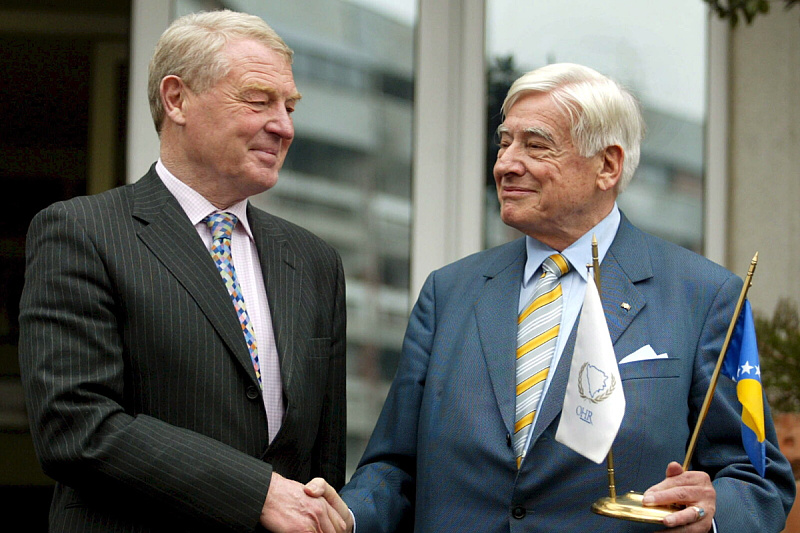
He left behind a multi-decade political and diplomatic career, largely tied to the Balkan region, and particularly to institution-building processes in Bosnia and Herzegovina. His professional journey moved from academic circles, through the highest positions in the German government, to international diplomacy.
An interesting coincidence and curiosity related to his death is the fact that he passed away precisely on April 6th, the Day of the City of Sarajevo. This date is closely linked to his later relationship with the Bosnian-Herzegovinian capital. Indeed, on this same date in 2020, the Sarajevo City Council made the decision to award Schwarz-Schilling the recognition of "Honorary Citizen of the City of Sarajevo."
This title was presented to him as official confirmation of his long-term diplomatic and political work, with emphasis on his activities during the 1990s when, traveling the region, he sought to direct the attention of Western countries to the need to resolve the conflict in BiH. The fact that he died on the day Sarajevo celebrates its most significant holiday gives a special framework to the conclusion of his life's journey.
Academic Beginnings and Political Rise in Germany
Christian Schwarz-Schilling was born on November 19, 1930, in Innsbruck, Austria. His early professional path was not necessarily tied to politics. After secondary education in Berlin, he enrolled in studies of history and East Asian languages and culture at Ludwig Maximilian University in Munich. He completed his academic education with a doctorate in Chinese history in 1956.
His interest soon shifted to economics and business. For years, he worked in managerial positions, and later founded his own company focused on telecommunications, which would prove key to his later political career. In 1960, he became a member of the Christian Democratic Union (CDU). Through party structures, he advanced to the position of representative in the Bundestag, which he entered in 1976.
His greatest achievement in domestic German politics came in 1982, when Chancellor Helmut Kohl appointed him as Federal Minister for Posts and Telecommunications. He spent a full ten years in this position, leading modernization processes and early phases of privatization in this sector.
Resignation in 1992 and Career Shift
In December 1992, Schwarz-Schilling made a decision that would completely change the direction of his work. He submitted an irrevocable resignation from his position as minister in Helmut Kohl's government. As the official reason, he cited sharp disagreement with the policy of his own government, and the broader international community, towards the war in Bosnia and Herzegovina.
He believed that European countries and international institutions bore some responsibility due to their passivity and unwillingness to adequately respond to the escalation of violence and violations of international law.
He explained his decision by the impossibility of being part of an administration that, in his opinion, was not doing enough to stop the conflict. The resignation of a minister over a foreign policy issue that did not directly concern Germany's own national security was a rarity in the European political practice of the time.
Role of International Mediator
After leaving the German government, Schwarz-Schilling dedicated himself to diplomatic work in the Balkans. His knowledge of the situation resulted in his appointment to the function of international mediator. Initially, he acted as a mediator for the Federation of Bosnia and Herzegovina (from 1995), and his mandate was later extended to the entity of Republika Srpska.
He remained in this position for an entire decade. His task was to resolve concrete, on-the-ground problems that hindered the implementation of the Dayton Peace Agreement. He focused on local communities, mediating disputes between local authorities, resolving property rights issues, and working to create preconditions for the return of refugees and displaced persons. His work was characterized by so-called "quiet diplomacy," without significant media presence, focused on the gradual building of trust and restoration of basic functions of local self-governments.
Mandate as High Representative (2006 – 2007)
Schwarz-Schilling was appointed to the function of High Representative of the international community in BiH, which also included the duty of Special Representative of the European Union, at the beginning of 2006. In that role, he replaced British diplomat Paddy Ashdown, whose mandate was recognizable for the frequent use of Bonn Powers, dismissals of officials, and imposition of laws.
At the beginning of his mandate, Schwarz-Schilling clearly communicated a drastic change of course for the Office of the High Representative (OHR). His official policy was based on the principle of "ownership of processes," which in practice meant leaving responsibility to domestic political actors. He believed the era of international imposition of solutions was over and that BiH institutions must take on the burden of decision-making, which he considered a necessary precondition for the country's integration into the European Union.
However, this approach faced numerous criticisms and different interpretations. Analysts and part of the public considered the withdrawal of the OHR to be premature, arguing that domestic political elites were still not ready to reach compromises without international pressure.
During his mandate, there was a stall in certain reform processes, with the most obvious example being the collapse of negotiations on constitutional changes known as the "April Package." Due to such circumstances, his mandate in political analyses is often assessed as a transition period that showed the real capacity, but also the limits, of domestic political structures at that time. He left the function in mid-2007, handing it over to Miroslav Lajčák.
Political Analyst and Critic in the Post-Mandate Period
Upon returning to Germany, Christian Schwarz-Schilling returned to business consulting but remained extremely active in monitoring the political situation in Bosnia and Herzegovina and the wider region. In the years that followed, he established himself as one of the regular commentators on Balkan affairs in European media.
In his analyses, he often warned the international community about the dangers of secessionist rhetoric and blockades of state institutions. He was open in criticizing the actions of leading ethnonational leaders in BiH, particularly emphasizing the destructiveness of policies coming from Banja Luka by Milorad Dodik, but also criticizing the approaches of Dragan Čović regarding electoral legislation.
He actively lobbied in the German Bundestag and EU institutions for a firmer approach towards those undermining the Dayton Agreement, advocating for targeted sanctions as a legitimate tool of international policy. His stance was that the European Union must have a clearer and more decisive vision for Bosnia and Herzegovina, and must not allow a security or political vacuum in the Balkans.