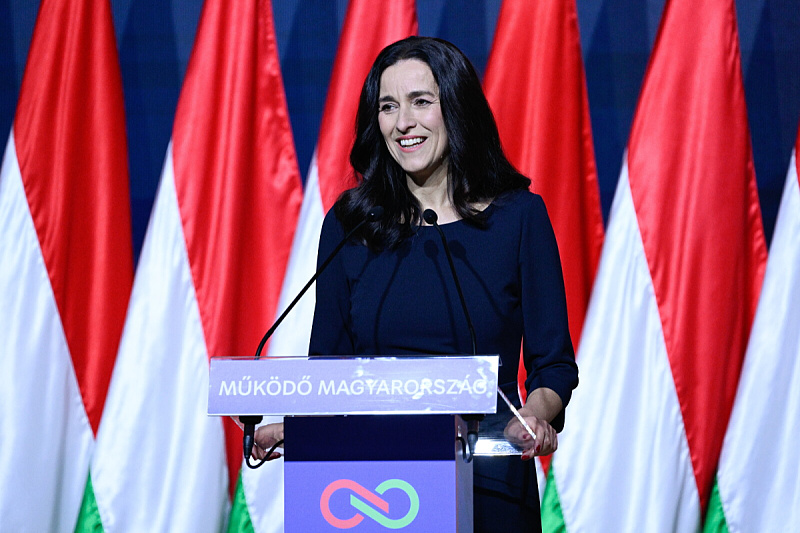
Hungarian media are already speculating that Magyar could appoint Anita Orban, who currently serves as the foreign policy expert within the Tisza party, as the foreign minister. "The Hungarian people have given the Tisza party a constitutional majority with a clear mandate—to restore the rule of law and return Hungary to its rightful place in Europe, among democratic nations. To all who helped us achieve this victory—thank you. From this moment on, we will work to earn your trust every day," Orban said after the election.
Who is Magyar's Foreign Policy Expert? Anita Orban (not related to Viktor Orban) has extensive international corporate experience and previously worked within Orban's government. After the victory of Orban's Fidesz in 2010, she was appointed to the Ministry of Foreign Affairs as Hungary's ambassador for energy security. However, she remained in the ministry only until 2015, when she expressed disagreement with the policies of Hungary's then-new foreign minister, Peter Szijjarto. Regarding her private life, in the early 2000s, Orban moved with her husband to the United States, where she earned bachelor's and master's degrees from Boston University and the oldest diplomatic academy in the U.S., the Fletcher School of Law and Diplomacy. Additionally, she worked as a consultant for British energy companies, particularly in the liquefied natural gas industry, and also served as deputy director of Vodafone. In a podcast organized as part of Tisza's pre-election campaign, it was also revealed that Anita Orban suspended her membership in two important organizations where she held high-ranking positions to focus on the pre-election campaign. One is the European Council on Foreign Relations, and the other is Globsec, which Fidesz politicians have referred to as a globalist, right-wing organization since Tisza's announcement of her appointment to this role. Regarding Tisza's future foreign policy, she stated that Hungary belongs to the West and that its status as a "ferry" country will end. "We will anchor ourselves in the Western alliance system," she said, adding that her first task would be to repair the thousand-year-old Polish-Hungarian friendship and redress the damage caused in recent years, which is also essential for the functioning of the Visegrad Group. Furthermore, she intends to strengthen relations with neighboring countries and resolve disputes with them. Regarding the EU, Orban previously stated that the organization currently functions as EU26 because Hungary has the most veto rights, the impact of which is also exaggerated. "That will also come to an end," she declared. Orban reflected on the fact that the Hungarian government has practically completely blocked Hungary itself in cooperation with the EU through constant attempts to obstruct the union's work, as they are most often the only ones vetoing in Brussels. Tisza would change this so that the country can once again become a respected member of the EU. Speaking about relations with Russia, Orban noted that Hungary is not sitting in the middle but on the Russian side of the table. "Tisza would return to the Hungarian side and establish a relationship with Russia without behind-the-scenes actions," she stated. Additionally, she revealed that their prime minister's first foreign trip would be to Warsaw, Vienna, and then Brussels, and he would also visit Zakarpattia, where a Hungarian prime minister has not been since 2015, despite four years of war.