This imbalance is killing some of the planet's most vital ecosystems, from the towering California redwoods to coastal seagrass meadows that store vast amounts of carbon and support complex food webs.
Marine heat waves, record wildfires and coastal development are pushing these systems past their limits as climate change, driven by emissions from fuels like oil and gas, accelerates. An estimated one million species are threatened with extinction, many within decades, largely due to human activities like habitat destruction, pollution and overexploitation, according to a 2019 report by a United Nations intergovernmental science body.
Scientists are trying to narrow that gap with a new discipline called conservation genomics: sequencing an organism’s full genetic blueprint to find individuals with traits suited for surviving drought, disease and other climate extremes, then using that information to guide restoration of threatened species and habitats.
Corals are among the first ecosystems where these genomic tools are already in use. Repeated marine heat waves, which have caused mass bleaching, have devastated reefs worldwide. By sequencing the corals and the algae that live within them, researchers have identified colonies that naturally tolerate higher temperatures and are beginning to test whether selectively breeding and cultivating these more resilient corals can aid reef recovery.
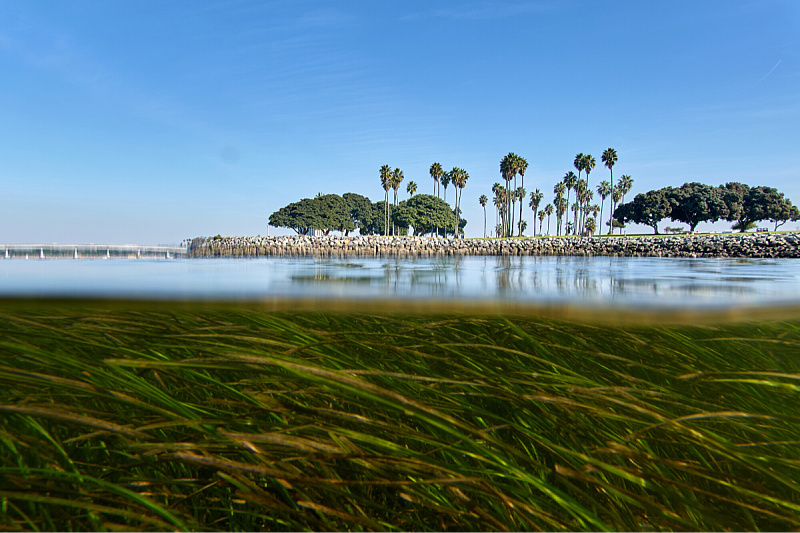
In Southern California, researchers are applying this approach to eelgrass, a type of seagrass, as traditional restoration methods increasingly fail. This plant provides habitat for fish, crabs and plankton, feeds migratory birds and sequesters carbon and methane, both heat-trapping greenhouse gases, into coastal sediments.
Conditions in San Diego’s bays are changing. Waters are warming. King tides, the highest annual tides, which climate change is making more frequent and intense, stir up sediment and reduce light reaching the seafloor. Development sends runoff into the bays, further clouding the water.
As a result, efforts to replant lost seagrass meadows fail roughly half the time.
"Conservation genomics is becoming especially important because the climate is changing right now, the plant that once grew great in San Diego Bay may now be suffering because that bay has become too warm for it," said Todd Michael, a research professor at the Salk Institute for Biological Studies.
In Mission Bay, Michael and his colleagues discovered a clue that could improve those odds: a naturally occurring hybrid eelgrass that outperformed its parent species. The plant, a cross between the shallow-water species Zostera marina and the deeper-water Zostera pacifica, persisted in locations where both parent species struggled.
By sequencing its genome, the team identified genes linked to the plant's circadian clock that remain active longer in low-light conditions, a pattern scientists believe may help it photosynthesize more efficiently in murky water.
The findings suggest restoration could be improved by selecting or breeding eelgrass better suited to future conditions. But for now, that work remains largely experimental and has not yet been applied at large scale in the field. Researchers have partnered with ecologists at the Scripps Institution of Oceanography to explore how these insights could be leveraged in future restoration projects.
Redwoods are among the tallest and oldest trees on Earth, and their forests store more carbon per hectare than any others, according to a 2020 study by the Save the Redwoods League and Humboldt State University.
While these species evolved with frequent, low-intensity fires, today's hotter, more destructive wildfires, combined with drought, are taking an increasing toll. Logging has had an even greater impact: about 95 percent of ancient redwood forests have been cut, drastically reducing genetic diversity.
Scientists have already sequenced the redwood genome — a massive undertaking given it is a genome nearly nine times the size of the human one.
Still, researchers emphasize it's not just about restoring what once was, but preparing forests for a climate that no longer resembles the past.
"An organism that at one point was adapted to a particular location, maybe it's not anymore," said David Neale, a forest tree geneticist and emeritus professor at the University of California, Davis. "It may require a different genetic variation to adapt to the new environment."
Initial analyses have begun linking genes to traits like drought tolerance and temperature adaptation, but researchers say more rigorous work is needed to confirm those links before they can be used to guide restoration. That work is slowed by limited funding.
"Genomics can be useful, but it's not a solution in itself," said Karen Holl, a distinguished professor of environmental studies at the University of California, Santa Cruz. "The priority should be reducing greenhouse gas emissions."
Genomic tools could help certain species, especially long-lived ones like redwoods that can't adapt on their own fast enough, but they have limits. Ecosystems are built on complex relationships between plants, animals, microbes and fungi. Engineering or selecting for climate-resilient traits in one species doesn't guarantee the survival of the many others that depend on it.
"Can you genetically engineer a few species to be more tolerant? Absolutely. But that's still not an ecosystem," Holl said. "We're not going to engineer our way out of climate change in the lab."