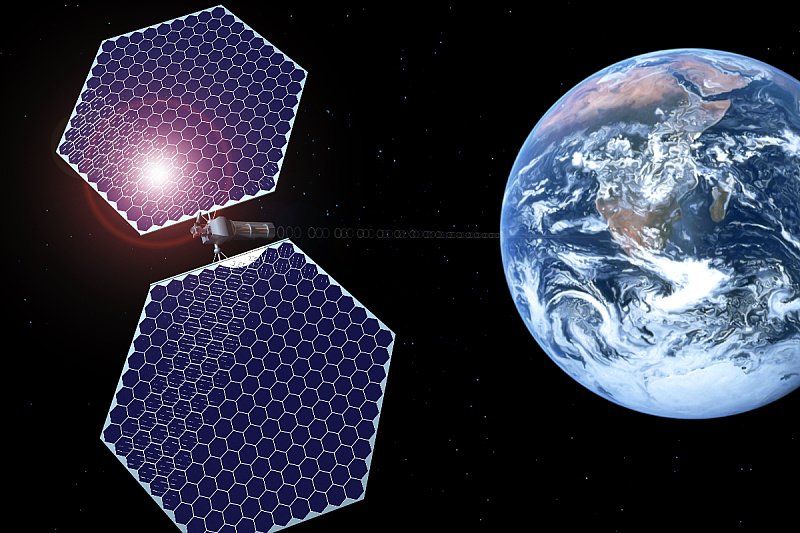
The concept is based on massive orbital infrastructure capable of collecting solar energy in space and transmitting it to Earth via tightly focused microwave beams. Such systems are typically considered as future sources of clean energy, but researchers say the same technology could also enable other strategic capabilities if adapted for defense purposes.
Recent work by Chinese scientist Duan Baoyan, a professor at Xidian University and the lead architect of China’s "Zhuri" or "sun-chasing" initiative, outlines a redesigned architecture for the project. According to reports, the revamped system could support multiple functions "such as communication, navigation, reconnaissance, jamming, and remote control," in addition to its primary role of transmitting energy from space.
As reported by Ling Xin for the South China Morning Post (SCMP), the system relies on extremely narrow, precisely controllable microwave beams capable of transmitting energy from orbit to ground-based receivers over long distances. Although designed for efficient energy transmission, the same beam-forming capability could theoretically be used to target communication systems, potentially jamming signals or securing military communications.
The technology falls under the concept of space-based solar power (SBSP), which involves collecting sunlight in orbit, where it is nearly continuous and unaffected by weather or day-night cycles. The energy is converted into electricity and then wirelessly transmitted, typically using microwaves or lasers, to receiving stations on Earth.
Researchers claim such systems could produce far more energy per unit area than terrestrial solar farms, as orbital panels operate without atmospheric losses or cloud cover.
China’s OMEGA design, short for Orbit M-shaped Exploration and Gigawatt Application, was first proposed in the 2010s and has since evolved into a modular architecture composed of multiple smaller solar collection units. The distributed design aims to simplify engineering challenges, improve thermal management, and ensure the system continues functioning even if some modules fail.
China is not alone in pursuing the idea of harnessing energy from space. Space-based solar power has attracted increasing attention from space agencies and research institutions worldwide. In the U.S., NASA has explored the SPS-ALPHA (Solar Power Satellite via Arbitrarily Large Phased Array) concept, which also relies on large arrays of modular solar collection units to send energy to Earth.
Meanwhile, researchers at the California Institute of Technology launched a prototype system, the Space Solar Power Demonstrator, in 2023. The project tested technologies including deployable structures, advanced photovoltaic cells, and a microwave array capable of wirelessly transmitting energy in orbit.
Europe is also studying the concept through the European Space Agency’s SOLARIS initiative, which assesses whether orbital solar power plants could continuously supply Earth with renewable energy in the coming decades.
Despite growing interest, the technology remains technically and economically challenging. Building kilometer-scale structures in orbit, transmitting energy over tens of thousands of kilometers, and maintaining precise beam control are among the major obstacles researchers still face.
Science-Fiction Ambitions and Strategic Implications
China’s efforts in space-based solar power are also accompanied by several other ambitious projects that highlight the scope of the country’s long-term space planning. These include concepts like the "Nantianmen Project," often described in Chinese media as a theoretical space-based aircraft carrier system, as well as proposals to build a nuclear reactor on the Moon to power future lunar infrastructure by the early 2030s.
Other missions already underway reflect the same experimental drive. For example, China’s Tianwen-2 mission is expected to attempt a complex asteroid sampling operation using robotic arms designed to anchor onto a rotating space rock. The country has also discussed futuristic launch concepts such as an electromagnetic rocket launch rail, which could accelerate spacecraft using ground-based electromagnetic systems instead of conventional rockets.
In this context, the Zhuri space solar system represents another piece of a broader technological strategy focused on long-term space infrastructure. While its primary goal remains continuously generating clean energy from orbit, its ability to transmit highly controlled microwave beams and support communication and navigation functions suggests it could also become part of a larger orbital network supporting satellites and other space systems.
Today, the technology is still experimental, but advances in wireless power transmission, modular space structures, and orbital manufacturing are steadily bringing ideas once confined to theoretical studies closer to practical testing.