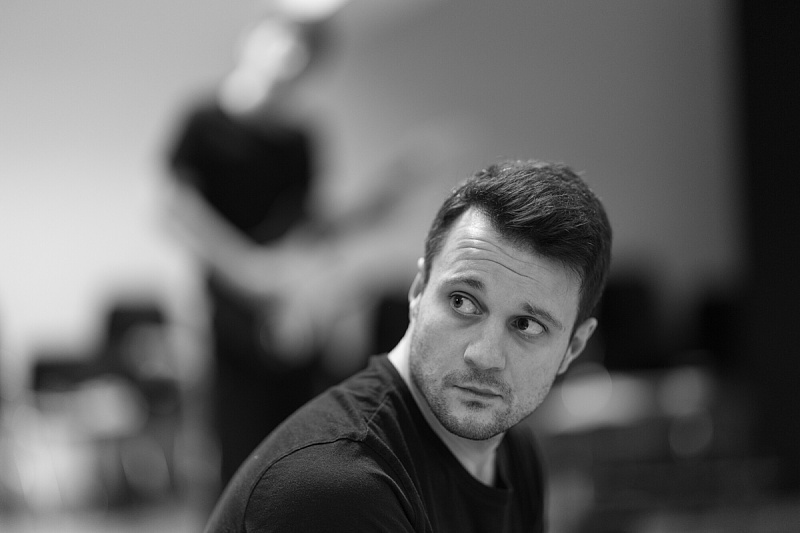
"Mekoća" is an authorial project created with colleagues Alban Ukaj, Boris Ler, Josip Stapić, Selma Spahić, and Emina Omerović. Additionally, the choreographer of the performance is Ana Kreitmeyer, set designer Paola Lugarić Benzia, costume designer Manuela Paladin Šabanović, and composer Draško Adžić. The performance "Mekoća" deals with the question of masculinity, examining the pressures and models of manhood deeply rooted in patriarchal patterns.
"Young Irish poet Daragh Fleming has a poem in which he says that if he ever has sons, they will be dangerous men. Men who will laugh at dogs, who will not allow pride to be the reason for their hiding, will not wear masks when something hurts them inside. They will know that vulnerability is strength. They will know that they are perfectly fine as they are, that they will not hide emotions, will not solve anything with violence, will reshape masculinity into something they will like, something that will be softer to the touch. They will be dangerous sons, but not in the way society expects. Such sons would indeed be the most dangerous men today. They would be in opposition to the entire patriarchal system," states Rizvanović.
This actor emphasizes how the patriarchal system forces many men to fight against tenderness, emotions, and everything a boy carries within himself from a young age.
"A boy is forced to fight against the softness within himself, to see it as some kind of virus, to remove and suppress that 'malignant' part of himself because only then can he integrate into society, to deserve to belong to something by that removal. To have friends because friends have long since removed theirs, they started training earlier, just waiting for him to fit in, and a boy needs friends," he said.
"The challenge is to explore a new world whose rules we only sensed"
Rizvanović points out that with the performance team, he tried to question whether some new world is possible, one where caring for others is the greatest goal.
"We examined 'radical softness' as an alternative to the world we live in. Truthfully, this system has been here for a very long time, and that's why it was a great challenge for us to explore a new world whose rules we only sensed. It was challenging to find ways to express tenderness, care, attention, without it being a cliché, and without being too invasive for the other person. We saw that it is much easier to find ways when it comes to violence or aggressiveness because such scenes are, unfortunately, more present in our lives. It is easier to support something you have often watched or witnessed more frequently," he conveys.
"There are no classic roles in the performance, every scene emerged from improvisations"
He explained that "Mekoća" is not a documentary performance, but through their work, they used their biographies because they wanted to find a connection with their upbringings and the question of what stops softness, why violence is the primary principle of societal organization, and which pressures of masculinity shape men.
"There are no classic roles in the performance. Every scene emerged from improvisations, so using that, as well as our relationships to the themes, Selma and Emina shaped four archetypes in which absolutely everyone will be able to find themselves. Humor is also an indispensable part of the performance, which in the end serves very well to emphasize its sharpness. 'Mekoća' is a very important performance for society today because every boy must grow up sometime. Everything he suppressed will have to surface someday. Very often, that takes the form of violence," he said.
This actor emphasizes that it is time to attempt to establish a new organization of society.
"Patriarchy shapes both men and women, and it turns out it is not good for anyone. The enormous pressures on men come precisely from that system, which tells them they must be strong, resourceful, enduring, physically superior, independent, aggressive, dominant, always there when needed, a hero, never showing weakness or emotions, silent, and hardworking. That is a huge amount of energy wasted. Few boys/men/sons, by some luck, find a channel for themselves, with the help of which they can be what they truly are. The rest, unfortunately, are only in service of the system and as if being prepared for the final act, militarization," he said.
It was created in co-production by INK Pula and SARTR. Besides Selma Spahić, the authorial team includes dramaturge Emina Omerović, choreographer Ana Kreitmeyer, set designer Paola Lugarić Benzia, costume designer Manuela Paladin Šabanović, and composer Draško Adžić. Tickets can be purchased at karter.ba and at the SARTR box office.
Speaking about plans for the upcoming period, Rizvanović said that he performs regular monthly repertoires at the Sarajevo War Theatre, and besides that, he will be part of the film "Quo Vadis Aida?: The Missing Part," which is currently being filmed.