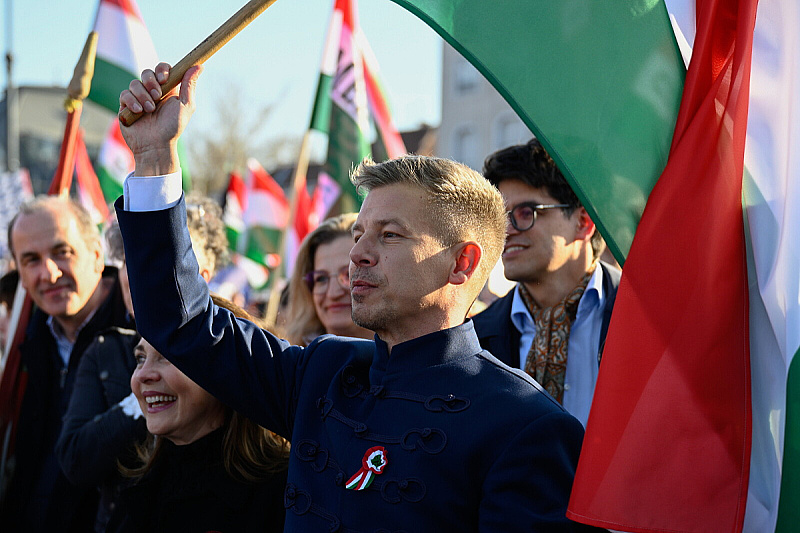
Peter Magyar has succeeded in securing two-thirds control of the Hungarian parliament, which will enable him to amend the Hungarian constitution and overturn many of the earlier moves made by Orbán during his absolute rule.
Tisza seeks to avoid political labeling, and Peter Magyar has stated that he wants to transcend the traditional left-right divide. He has also promised that Tisza will never form an alliance or coalition with any of the "old opposition" in Hungary, which he has condemned as inherently corrupt.
However, Magyar positions himself as a firmly pro-European conservative liberal, criticizing Viktor Orbán’s confrontational approach toward the EU and his ties with Moscow. He advocates for Budapest to adopt the euro once the country meets the necessary criteria for the common currency and supports a free-market economy.
Nevertheless, while nominally pro-Western and advocating for greater European integration, Magyar is also something of a traditionalist, emphasizing the importance of national cultural heritage. Both he and his party, Tisza, support the strict immigration controls implemented by Orbán and Fidesz.
Magyar came into the spotlight in Hungary when he wore a traditional Bocskai at a major national commemoration in 2025, widely interpreted as a signal to the nationalist segment of society.
On the politically sensitive issue of Ukraine, Magyar has sought to maintain balance. Orbán has made this issue central to his fight to remain in power, portraying Magyar and Tisza as pawns of Kyiv and the Western alliance allegedly seeking to drag Hungary into war.
Faced with such rhetoric, Magyar has tried to act in a pro-European and pro-Ukrainian manner while simultaneously emphasizing the importance of humanitarian aid over military support and advocating for a ceasefire to align with Orbán’s "peace above all" narrative.
He has also expressed opposition to an accelerated EU accession path for Ukraine. Since Magyar took over Tisza, the party has grown from a small group founded in 2020, which lacked the resources to participate in the 2022 parliamentary elections, into an opposition movement that has fundamentally defeated Orbán.
The party’s platform was developed based on a national survey Magyar launched in 2025, which gathered over a million responses from a population of about 9.5 million.
As a member of the European People’s Party group in the European Parliament, Tisza has moved away from its conservative roots and become a right-of-center party, seen by many as an extension of Magyar’s personal politics.
Although the party still avoids clear ideological labeling to attract the broadest possible voter base, one dominant theme since its founding has been the fight against corruption. Magyar has gained a reputation as a vocal opponent of backroom political deals. He has described Hungary under Orbán as a "mafia state" and distanced himself from other opposition groups he considers complicit in systemic corruption.
On social issues, Tisza stays on the sidelines, and Magyar himself avoids being drawn into "culture wars" with Fidesz, stating that doing so would mean falling for "government propaganda."
Peter Magyar emerged from Viktor Orbán’s political "wing," and as he himself admitted, he kept an Orbán poster in his room as a boy. Magyar does not belong to the ranks of "liberal" politicians, and leftist political ideas are as foreign to him as they are to Orbán.
It is clear that Hungarian society, where the left has been erased from the political scene, has essentially brought to power a party that is more of a classic conservative option than the previously far-right populist Fidesz.