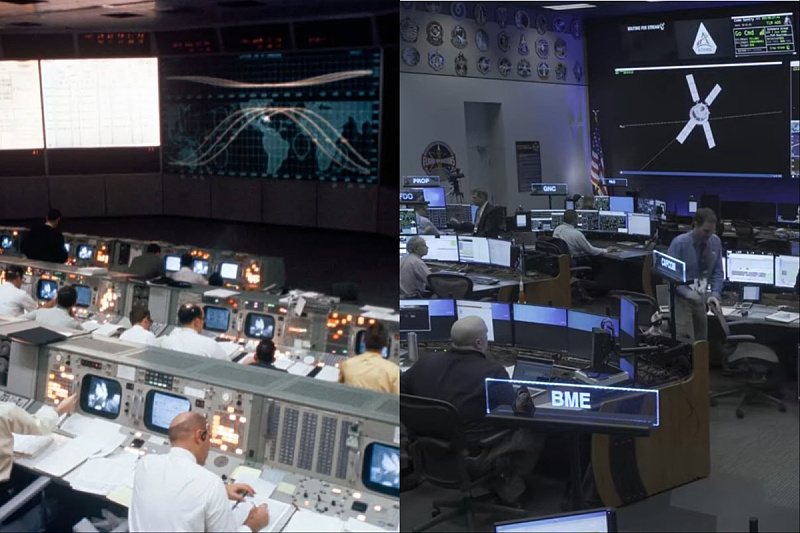
Namely, NASA has released a photograph of the Apollo mission control center, which made history by sending astronauts to the surface of the Moon. The first photograph released by NASA dates back to 1969, when humans first reached the Moon. In the control center on the outskirts of Houston, one of the rooms was fully equipped with state-of-the-art systems for that period. Behind all this stood an advanced global communication system and five of the latest IBM 360 computers, which analyzed every aspect of the spacecraft's speed, trajectory, and condition in real time. Each workstation was responsible for a different system on the spacecraft. The knobs on both sides of the monitor were positioned so they could be easily replaced in case of failure—a fairly common occurrence with cathode-ray tubes (before flat-screen technology, repairing televisions was a lucrative business).
Many switches are used for communication, and controllers could "join" conversations with their teams at other locations, speak directly with the flight director, or communicate with everyone else in the room. More than 50 years later, the control center in Houston has taken on a completely new appearance, and the number of screens and computers used to monitor all processes in space is difficult to count. Today, Houston has two main operational control rooms—one for the International Space Station (ISS) and a new one for Artemis. The team in Houston will be responsible for keeping the mission on track and safely returning the crew to Earth 10 days later. Working in three shifts, 24 hours a day, mission control will communicate with the astronauts, send commands, and monitor everything from trajectory and propulsion systems to the astronauts' heartbeats. Another unusual aspect of Artemis II is that the crew will be out of contact with Earth for about 40 minutes when it "disappears" behind the Moon. The trajectory and laws of physics mean the spacecraft will definitely return. However, this will not lessen the tension in the control room, which will remain the most critical lever for this historic mission even during that period.