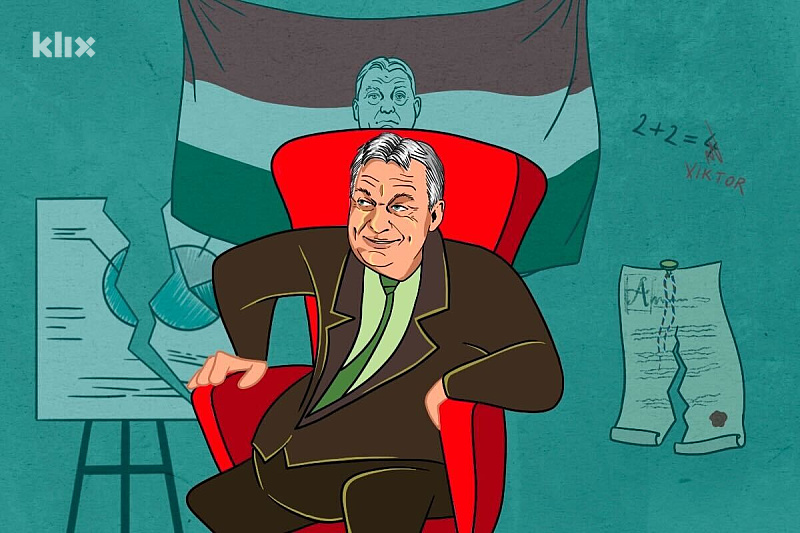
Of course, it is difficult to attribute Viktor Orbán's victories solely to the electoral system, which he has been involved in shaping from the very beginning. The division of the opposition and their disinterest in areas outside the "second district," i.e., Budapest, have significantly distanced Orbán's opponents from any serious results.
However, the electoral system in force since 2011 has definitely handed Orbán the strongest weapon a politician in the country can possess. How did it all begin? Looking at the broader picture of Hungarian politics, it could be said that Orbán's idea at the start of his rule had a "noble" purpose. It would become apparent in the coming years that such a view was rather naive.
Since entering the modern era, with the collapse of the Warsaw Pact and the USSR as the "ideologue" of the then Eastern Europe, Hungary, like many other countries, struggled with a cumbersome and inefficient system, best reflected in its politics. The Hungarian parliament had 386 representatives, and the electoral system had a major flaw—citizens rarely understood what exactly they were voting for and how their votes were counted in terms of the final outcome.
There were 176 single-member districts (SMD, where only one candidate wins per district), 152 seats on so-called regional lists, and 58 national compensatory seats allocated based on "lost votes." Lost votes were aggregated with the votes of losers who could not secure any seat (losing SMD candidates). This level aimed to introduce additional balance into the system.
Due to this system, voters often had multiple parallel voting levels, and in single-member districts, a two-round voting system was in place.
At the time, voters in Hungary cast one vote for a candidate in their single-member electoral district, one vote for a party list in their regional list, and finally, one vote counted in the national list. Despite bringing cumbersome bureaucracy with it, this system was, in the opinion of many Hungarians, extremely well-balanced and allowed for significantly greater equilibrium among parties.
Nevertheless, 2010 marked a turning point. Viktor Orbán, once a young liberal and "child of the revolution" that gave birth to modern Hungary, and his party Fidesz won the elections decisively. The victory was so convincing that Fidesz could form a government alone and, most importantly, change the electoral law, which was done as early as 2011 when Orbán began laying the foundations for complete dominance.
Looking at the changes Orbán embarked on at the time, it can be seen that many of them made sense. By the end of 2011, a decision was made to reduce the number of parliamentary seats from 386 to 199, justified by the fact that Hungary, relative to its population, had one of the most cumbersome parliaments in all of Europe.
However, parallel to this process, Orbán's Fidesz also altered the electoral system by reducing the number of single-member districts to 106. Their share in the allocation of parliamentary seats increased from 46% to 53%, and the second round of elections was abolished, allowing candidates to enter parliament with a minimal victory in the first round, which would particularly benefit Viktor Orbán in the coming years of his rule.
The most relevant change in the single-member electoral units system is that electoral units were created mostly identical in size, and the absolute majority procedure was replaced by a relative majority procedure.
Additionally, the system of the so-called national list, from which 93 representatives are elected, was also modified. In this case, citizens do not vote for candidates themselves but for parties, and votes are further distributed according to specific formulas. Here, it is particularly interesting that Orbán introduced the so-called "winner compensation" system, which significantly affects the final voting outcome.
For example, if a Fidesz candidate receives 20,000 votes in a single-member electoral unit and an opposition candidate receives 10,000 votes, the difference, i.e., the "unused votes," will be transferred to the national list and allocated to the winning party, which since 2010 has been Fidesz.
On top of this, the 5% electoral threshold carried over from the previous electoral system was further modified to penalize any party grouping. If two parties form a pre-election coalition, their threshold rises to 10%. For coalitions of more than two parties, the threshold goes up to 15%.
Moreover, Orbán recognized the importance of the diaspora and enabled Hungarians abroad to vote, which would prove crucial for keeping Fidesz in power.
To make matters even more interesting, recognizing the influence Fidesz has on Hungarians in neighboring countries, Orbán introduced additional amendments to the electoral law, allowing Hungarians abroad without a residential address in Hungary to vote by mail without going to polling stations or dealing with bureaucratic procedures accompanying every vote.
On the other hand, Hungarians temporarily living abroad are forced to vote at Hungarian embassies or consulates in those countries. Which of these two groups benefits Fidesz and Viktor Orbán? You can guess only once.
The 2011 electoral reform provided Fidesz with a structural advantage, demonstrated by its victory in 2014 in 91 out of 106 single-member districts (86%), despite winning only 44% of the votes on national lists.
A similar trend continued in subsequent electoral cycles. Orbán and his Fidesz won elections even though vote percentages did not indicate it was possible.
Gerrymandering—the word that turns the electoral system into a nightmare.
In addition to Fidesz changing the basic elements of the electoral system and fully adapting it to itself, the process that caused additional controversy was further amendments to the law enabling manipulation of electoral units, i.e., districts, known worldwide as gerrymandering.
Years before elections, the ruling party adjusts the boundaries of electoral districts in such a way that opposition voters are grouped into larger electoral districts, while districts dominated by Fidesz are further fragmented, allowing easier manipulation and ensuring Fidesz victories, as reported by OSCE and the Venice Commission.
Although the process itself is legal and often justified by demographic changes, the situation on the ground indicates that demography is secondary, with the focus on party interests.
Within the gerrymandering process in Hungary, phenomena described as "packing" and "cracking" of electoral districts have been recorded.
"In the first case, the political camp of opponents is drawn into one district so that they win there but lack enough voters for individual victories in other districts. In the second case, the voter camp of opponents is mixed with their own voter camp, allowing individual victories even in areas where the opponent was in the majority," write Hungarian analysts.
The last change to electoral districts occurred in 2024 and will directly affect the elections to be held on April 12, 2026. Out of a total of 106 districts, Fidesz changed the boundaries of 39. Budapest, the opposition's bastion, now has 16 electoral units instead of the previous 18.
Electoral units consisting of districts with the highest number of opposition voters were divided so that they are mixed with predominantly Fidesz voters.
Interestingly, certain urban districts of Budapest were mixed with peripheral, more rural areas where Viktor Orbán has ruled sovereignly for years, which many see as an attempt to further stifle the opposition ahead of the elections.
Of course, in the context of gerrymandering, it is inevitable to mention the disunity of the opposition, which further contributed to the development of this controversial system. For years, due to ideological differences, the opposition failed to find a candidate who could represent a unifying factor for all those dissatisfied with Orbán's rule.
However, the situation in 2026 has changed significantly. Facing Orbán now is a man far from the ideal candidate but whose greatest advantage is precisely that he grew up politically under the system whose foundations Viktor Orbán and Fidesz laid in 2011.
Péter Magyar knows absolutely all the advantages and disadvantages of the system, and through his campaign strategy, he has shown how easily he finds ways to get inside Fidesz's head and take control of pre-election provocations, which were not lacking in this campaign either.
For now, judging by pre-election polls, it seems that Péter Magyar and his TISZA party are on the path to victory, but to achieve it, they will also need to defeat the system. A system tailored and adapted exclusively to the measure of one man. If he succeeds, Péter Magyar's victory, considering everything the opposition faces, will represent much more than merely seizing power.