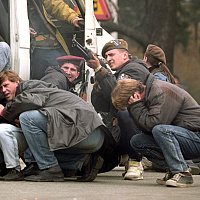
Then came the first victims of the longest siege of a capital city in modern history. On April 5th, at the Vrbanja Bridge, girls Suada Dilberović and Olga Sučić were killed. The next day, Karadžić's criminals, firing sniper rifles from the SDS offices in the Holiday Inn, killed four people and wounded at least ten.
On that fifth day of April 1992, citizens spontaneously gathered near Dobrinja and began the largest demonstrations for peace in the modern history of Sarajevo.
Today, footage from that day can be found online. In a Yutel broadcast aired on TVSA, a column of several thousand citizens was shown near the Nedžarići Student Dormitory, calling on students to come out. A bit later, they were recorded on the main road near the Alipašino Polje neighborhood singing the song "Bosno moja, divna mila, lijepa, gizdava..." ("My Bosnia, wonderful dear, beautiful, elegant...").
TV crews took statements from the gathered citizens who said they were not afraid and that "you only die once."
The column arrived a bit later at the Parliament of Bosnia and Herzegovina building, and behind it, the first armed conflict occurred. From a house near the Vrbanja Bridge, Karadžić's sympathizers fired upon unarmed citizens of Sarajevo who defended themselves with stones.
Then Suada and Olga were killed, and several citizens were wounded. The bridge was later renamed the "Suada and Olga Bridge."
Shooting from the Holiday Inn
The peace demonstrations continued the next day. Then the situation completely escalated, and it became clear that the war had begun.
Karadžić's criminals opened sniper fire from the 6th and 9th floors of the Holiday Inn, where the SDS offices were located.
Shortly after, Dragan Vikić's special forces stormed the hotel and arrested six Serbian snipers. In the archives of the Ministry of Internal Affairs of the Republic of Bosnia and Herzegovina, there were fingerprints on the sniper rifles, bullets extracted from wounded citizens and matched to the rifles, and photographs of the locations from which the shots were fired. However, none of those snipers were ever prosecuted; instead, they were all later exchanged under Karadžić's threats to indiscriminately shell civilians.
During those two days, the forces of the Yugoslav People's Army and the SDS paramilitary formations seized the MUP school in Vraca, which allowed them to control the city from the heights.
Then shooting began in numerous other settlements in what is now the Sarajevo Canton, such as those in Stari Grad and Ilidža.
Telephone lines began to be cut, and exits from the city were blocked from all sides until the end of the war. Sarajevans lived for years without electricity, water, and food.