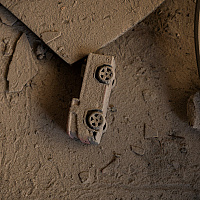
First came the sound of shattering glass. Then an explosion. Dazed and disoriented, Wahhad stepped out into the open garage of his building in an otherwise quiet residential neighborhood in central Beirut.
Four people were scattered against the wall of his complex, thrown from a neighboring building just 10 meters from where Wahhad sleeps at night.
Only one of them was alive, but severely injured, he said, and their blood remained splattered across the wall the next day. Wahhad helped him down the stairs, tending to his wounds on a pile of gravel, twisted metal, and children's toys.
"At first, I didn't understand why the ambulance was taking so long. We thought it was just us, but we soon realized all of Beirut was burning, all of Lebanon," he said.
Wahhad's building in the Manara district along Beirut's coast was hit just after 2 p.m. on Wednesday. Israel claimed it struck 100 targets across Beirut, the Bekaa Valley, and southern Lebanon in less than 10 minutes, marking one of the deadliest single bombing campaigns in the country's history, which has been marked by decades of war and destruction.
In that attack on Wednesday, Israel killed at least 303 people and wounded more than 1,150 others, according to Lebanon's health ministry.
The death toll was expected to rise: rescuers, their faces ashen and hands bloody, were still pulling bodies from the rubble at multiple locations in Beirut on Thursday afternoon. The casualty count was higher than that of the 2020 Beirut port explosion.
Nearly simultaneous bombings hit more than 50 locations across the country, according to an FT review of state news reports, ranging from previously spared central Beirut neighborhoods to a mountain town that had been providing refuge for the displaced.
The attack followed confusion in Lebanon over whether a ceasefire agreed between the US and Iran the previous night also applied to the country. While Pakistan and Iran claimed Lebanon was part of the deal, Israel and the US denied it. Some displaced Lebanese had begun returning home, believing the war was over.
Israel called Wednesday's attack Operation "Eternal Darkness" and stated it had targeted Hezbollah's "command and control centers," killing over 200 "terrorists"—a description that made little sense to many living in the affected residential buildings.
Although numerous residents told the FT they had known some of their neighbors for "decades" and had seen no evidence of Hezbollah fighters, they quietly admitted the attacks had made them question their own beliefs as well.
"It's impossible to say for sure who lives where, especially since the displaced started arriving," said one survivor.
In Beirut, the FT saw several high-rise buildings in densely populated residential and commercial districts where dozens of apartments had been reduced to rubble or blown apart.
Outside the capital, the attacks also hit a funeral procession, two aid distribution centers for the displaced, a hospital, and mothers who were out walking with their babies in strollers in the afternoon, according to FT and local media reports.
Israel announced it had killed Ali Yusuf Harshi, the personal secretary and nephew of Hezbollah leader Naim Qassem, on Wednesday. Among the dead were also numerous children, a poet, an activist for the victims of the 2020 Beirut explosion, two journalists, and four Lebanese army soldiers. The health ministry noted that 110 of those killed were children, women, and the elderly.
Residents of Beirut moved in a state of confusion, caught off guard by the unexpected violence of the attack and trying to contain a growing panic as nowhere seemed safe anymore.
Some tried to continue with their daily lives: fishermen were at the pier, taking advantage of the unusually fine weather, while taxi drivers desperately tried to find fares amid the lack of people on the streets, given the general mood in the country.
And there were those who wandered between attack sites, trying to grasp the scale of the assault. They watched civil defense workers trying to locate the missing in the Tallet al-Khayyat neighborhood of central Beirut, where an Israeli strike had left a massive crater and damaged several buildings.
"If I hadn't been at university, I probably would have been dead," said Mohammad Diab, a 24-year-old accounting student, watching residents of a neighboring building throw broken glass and blast debris from their balconies in buckets.
"There's no longer such a thing as 'safety.' How can we be safe? It's clear this was Israel's message that they will hit us whenever and however they want," Diab said.