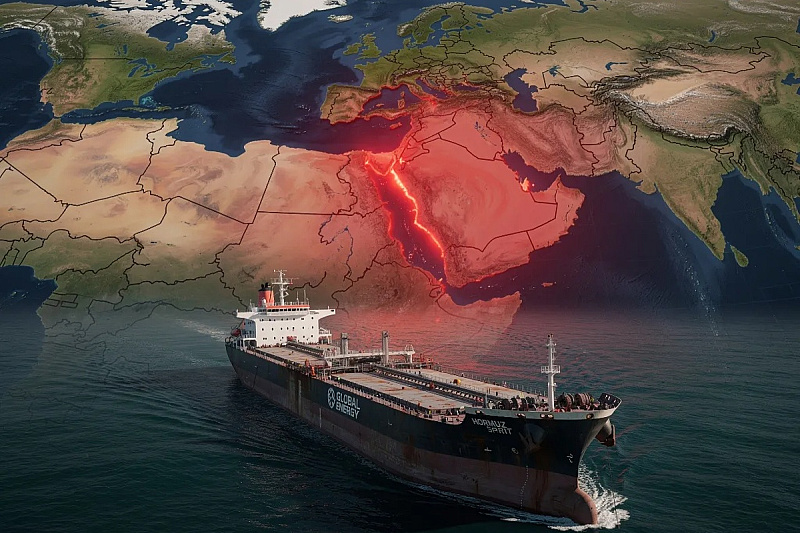
On Wednesday, crude oil prices fell between 13% and 15%, bringing both Brent and WTI to around $95 per barrel. However, this is still higher than pre-conflict levels, as Brent closed at $72.50 per barrel on February 27, and WTI at $67. Compared to December, before the conflict began, the difference is even greater: $60.90 and $57.40, respectively.
In the best-case scenario, a ceasefire will serve as a springboard for a peace agreement by the end of the month. However, oil production, damaged by attacks on energy infrastructure and saturated storage facilities, will take months to recover.
Furthermore, markets will continue to apply a risk premium for some time due to uncertainty about future supply disruptions. According to the U.S. Energy Information Administration (EIA), these two factors will keep crude oil prices elevated until the end of 2027.
Moreover, some refined products, such as heating oil, will not return to pre-war prices until 2028. This is according to their latest monthly forecast, which ended on April 6 and assumes the war will continue until the end of the month, with a gradual reopening of the Strait of Hormuz—a scenario the parties are currently hoping for.
The agency estimates that Brent crude will return to its pre-war level (February 2026) in November 2027, while WTI will take an additional month. Despite this, both crude oils will end next year 8.7% and 10.4% higher, respectively, than in December 2025. The forecast for U.S. refined products is similar—gasoline will return to its pre-war level in November 2027, and diesel in December.
Bunker fuel, a key fuel for maritime transport, will not return to its pre-war level within the entire reference scenario but rather in 2028. According to the EIA, this is due to a global shortage of crude oil and other refined products.
Crude oil from the Persian Gulf is essential for producing heavy heating oil, which generates residues during the refining process used in the heating oil blend. Refining other types of crude oil, such as WTI, does not have the same capacity for subsequent heating oil production.
Like the EIA, markets indicate that despite a ceasefire, distrust will persist, and an additional premium will be applied due to fears of future disruptions.
Transit remains a high risk for insurers and shipowners, who will wait to see if the ceasefire holds before resuming operations. Furthermore, there is no clarity regarding the conditions Iran demands for passage permits, including payment of fees, and Tehran once again closed tanker transit in the mid-afternoon following another Israeli attack on Lebanon.
The main impact of the war in Iran on the oil market remains concentrated on prices. The EIA predicts that crude oil and other product production will recover in the fall, reaching 107 million barrels per day, compared to 98 million in March and 96 million projected for April.
For other products, such as LNG, tensions could rise again in the summer, coinciding with the filling of storage capacities, as the destruction of a significant portion of Qatar’s production capacity will affect the amount of LNG available.
The forecast does not detail trajectories for all producer countries affected by the agreement (Iraq, Saudi Arabia, Kuwait, the United Arab Emirates, Qatar, and Bahrain), though it indicates that crude oil production suspensions in these countries would decrease by 7.5 million barrels per day in March and rise to 9.1 million in April. If the war ends this month, the suspension would decrease to 6.7 million barrels in May.