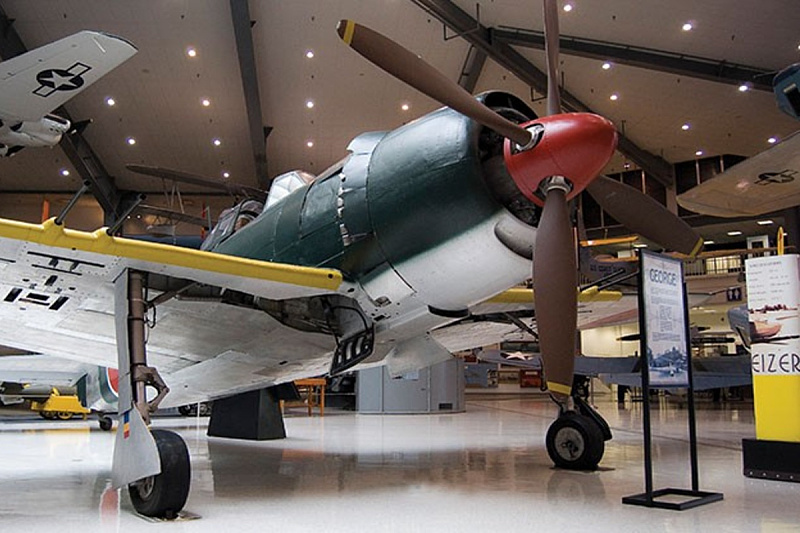
This Shiden-Kai fighter crashed off the coast of Kagoshima Prefecture on April 21, 1945, and its pilot, Lieutenant Hayashi Yoshishige, died on impact. Its location had long been known, as it lay on the seabed at a depth of less than three meters and was visible even on clear days.
After spending 80 years submerged in turquoise waters, a local heritage preservation group organized a project to rescue this rare Japanese aircraft. The technologically advanced military aircraft withstood the water better than initially expected.
Thanks to the aircraft's preservation, rescuers attached cables to each part of it and then lifted it from the seabed with a crane. It was a spectacular sight to watch as the "gray ghost" hovered above the blue-green waters off the coast of Kagoshima Prefecture, a haunting reminder of its crash long ago.
The team hopes that the aircraft, in addition to providing insight into wartime aviation, will convey wisdom about the real consequences of war during this time of global unrest. It is currently on a barge and will soon be moved to a port for conservation.
In December 1941, Kawanishi's engineering team had nearly completed the design for a "new and improved" Japanese seaplane fighter.
The Allies called the Shiden-Kai "George," a seemingly innocuous name for an aircraft the Japanese called "Violet Lightning-Improved."
This heavily armed and maneuverable fighter represented a significant advancement the Japanese made in improving technology during the war.
After its flight after Christmas 1942, only 1,435 of these fighters were produced before the end of the war, according to the National Museum of Naval Aviation.
Equipped with two 7.7mm machine guns mounted on the fuselage and four 20mm cannons, the Shiden-Kai was developed to improve Japanese defense. Its revised wing configuration and improved handling gave it impressive maneuverability and range, making it a dangerous opponent.
"The new aircraft was powered by an 18-cylinder Nakajima Homare radial engine with approximately 2,000 horsepower and a 3.4-meter four-blade propeller, significantly enhancing performance," described the National Museum of Naval Aviation.
One Shiden-Kai, or "George," even single-handedly attacked 12 American F6F Hellcats, eliminating four and forcing the others to break contact. However, it still had shortcomings, such as late production and material shortages, which hindered its ability to challenge American air superiority, reports Heritage Daily.
"The large propeller, combined with the mid-fuselage wing, dictated long landing gear legs, resulting in landing gear issues. B-29 Superfortress bombings in the later months of the war further reduced the aircraft's effectiveness by destroying aircraft and production facilities," stated the National Museum of Naval Aviation, meaning only a limited number of these World War II fighters were produced, most of which were used to defend the Japanese archipelago.
While the aircraft is in port, the team will spend the next year addressing salt deposits before eventually displaying the aircraft to the public.