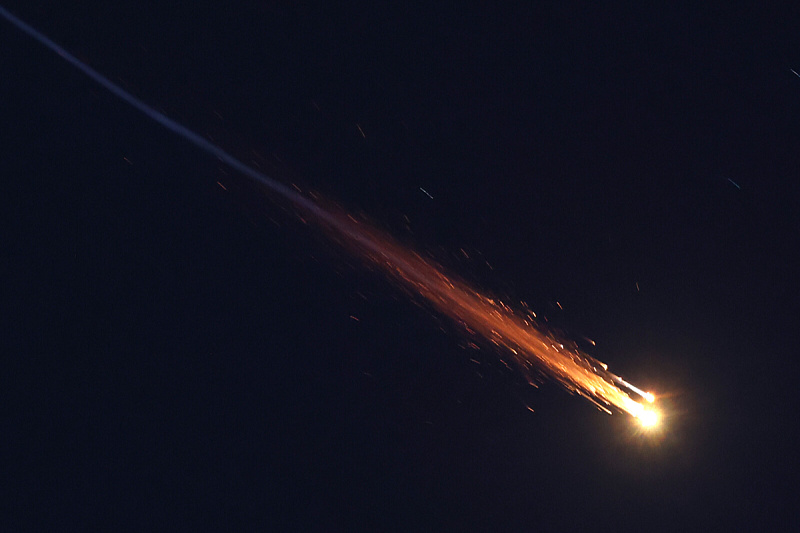
Every fourth projectile launched toward Israel in the last week of the war with Iran penetrated the air defense systems. According to Haaretz's analysis, this data is part of a trend: as the war progressed, the proportion of missiles that were not intercepted and caused damage increased.
Most of them were cluster munitions, for which Israel has failed to develop a specific response, although they were not entirely new, as Israel had already encountered them in the war last June.
According to Haaretz's monitoring, Iran launched about 650 projectiles toward Israel during the 40 days of fighting. The estimate is very similar to that recorded by Israeli systems, a security source told Haaretz. The data shows that a total of 77 projectiles managed to penetrate the defense and hit targets: 16 with a single warhead weighing 100–500 kilograms of explosives, which caused the deaths of 14 people; and 61 cluster projectiles, i.e., projectiles that release dozens of smaller bombs with several kilograms of explosives scattered over a wide area.
They caused at least 380 significant destruction zones, resulting in the deaths of six people in Israel and four Palestinians in the West Bank. At least five people were seriously injured.
For comparison, during the 12 days of fighting in June last year, Iran launched about 530 ballistic projectiles toward Israel. At that time, Haaretz documented 35 missile hits that penetrated the defense, of which 32 were with a single warhead and only three were cluster munitions.
High-ranking military sources speaking to Haaretz stated that out of about 650 projectiles fired in the current campaign, several dozen fell in open areas and did not require interception. The sources claim there is no shortage of interceptors, but due to the length of the war, they had to manage the risks of hits while preserving stockpiles. For this reason, they also used additional systems that were only recently adapted for intercepting ballistic missiles, including the "David's Sling" system. However, this system is not necessarily effective against cluster projectiles.
"David's Sling" was originally designed to intercept long-range rockets. It can now also act against ballistic missiles launched from a distance of about 2,000 kilometers, but with a limitation: interception occurs within the atmosphere. This differs from the "Arrow 3" system, which intercepts projectiles outside the atmosphere—a key distinction. However, "Arrow 3" is the most expensive interceptor in the Israeli military (about $3 million per projectile), and its stockpiles are limited, especially after intensive use in the June war.
The stockpiles of American THAAD missiles have also been significantly reduced after last year's war, and the remaining ones are deployed in Gulf states to protect against Iranian attacks. Therefore, during the war, the question was not only whether there were enough interceptors but also what type they were.
As a rule, as soon as a projectile is launched from Iran, the Air Force interception center tracks it in real time. After assessing the impact zone, a decision is made: let it fall in an open area or attempt interception and with which system.
However, there is another problem: the Israeli military cannot always determine with certainty what type of weaponry the projectile carries—a conventional warhead or cluster bombs. If it is cluster bombs, they disperse at an altitude of about ten kilometers, so only systems that intercept at higher altitudes, such as "Arrow" and THAAD, are effective against them. If "David's Sling" is used, the projectile may have already dispersed its submunitions.
The data shows that the penetration rate of the defense increased as the war progressed. In the first seven days, about 220 projectiles were fired, and only 5 percent hit targets, with ten fatalities. In the second week, the number of launches dropped to about 100, but the hit rate rose to 7 percent. In the following two weeks, it increased to 16%, then to 23 percent. In the last five days of the war, the worst results were recorded: about 60 projectiles, of which 27 percent hit targets.
According to Israeli military sources, most projectiles had a single warhead, but most of those that penetrated the defense were cluster projectiles (61 out of 77). The explanation given by military officials relates to the "interception policy"—a set of complex decisions regarding stockpile management, protection of strategic targets, and the population.
The standard decision is to intercept, and the decision not to do so is made at the last moment. The problem with cluster projectiles is that they break apart long before hitting the ground.
Military officials also emphasize the importance of protective measures for civilians. Cluster bombs can cause significant damage and destroy homes, but not to the extent of large warheads that can collapse entire buildings. The data shows that the victims were mostly people who were not in shelters.
The most significant damage was recorded in Tel Aviv, Petah Tikva, Bnei Brak, and Ramat Gan, where hundreds of people were evacuated, and many were left homeless.
Cluster bombs often fall almost simultaneously, creating dozens of smaller impact zones over a large area. Their explosion creates fragments that act like a "rain of knives," making them extremely dangerous and lethal.
The increased use of cluster munitions is not the only change compared to previous conflicts. According to military sources, Iran increasingly targeted the southern parts of the country, and over time, the focus shifted from military targets to populated areas.
The Israeli Ministry of Defense did not wish to comment in detail on the interception policy, explaining that they do not want to reveal information to the enemy. It was stated that the multi-layered defense system saved many lives and that work continues on its improvement.