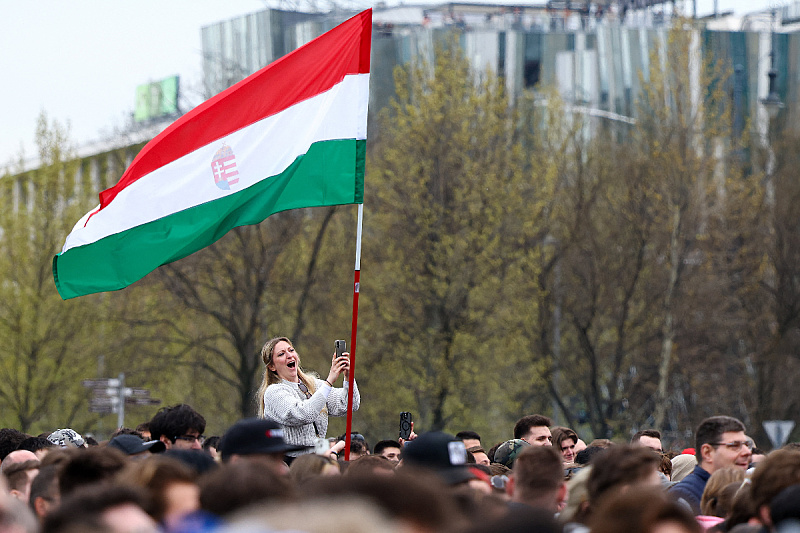
This Central European country will today, it seems, be the focus of Europe and a good part of the world. Its results will resonate in the immediate and wider region, the continent, and even in Washington and Moscow, as everyone will closely watch who will emerge victorious.
On one side is Viktor Orbán, Hungary's prime minister for 16 years, whose Fidesz party hopes to survive the biggest opposition attack on power since 2010, when he came to office. Orbán has tirelessly campaigned by linking his opponents to Brussels and Ukraine, presenting himself as the only steady hand that can independently lead Hungary into the future. He has the support of a host of right-wingers and radicals across Europe and the world. From U.S. President Donald Trump to right-wing parties in Europe and even Aleksandar Vučić in Serbia, the radical current has a clear message: Orbán should continue with sovereign rule in Hungary.
On the other side is Péter Magyar, the charismatic opposition leader and former Fidesz operative, a man who once had an Orbán poster in his room. Since leaving Fidesz and forming the Tisza party, Magyar has demonstrated an incredible political rise and is identified as the man who could bring down Orbán, who has tried to build an image of an invincible politician. Regardless of the outcome, Magyar has run a campaign worthy of objective praise. He skillfully avoided numerous scandals that were, in a way, set up for him. He and his colleagues have also toured almost the entire territory of Hungary, with fieldwork yielding results.
According to most polls, Tisza has an advantage ranging from seven to ten percent, maintained over the past year and a half since Magyar's party took the lead over Fidesz. If Magyar were to win, he would not only defeat Fidesz and Orbán but also the electoral and social system built over a decade and a half specifically to defend against the opposition. Changes to the electoral system, gerrymandering districts to favor Fidesz voters, media blockade, and diaspora mobilization are just some of the things Orbán has built over time as a defensive block.
If Magyar manages to topple him, he would disappoint many right-wingers worldwide who viewed Orbán's "illiberal democracy" as a model system they would gladly implement in their own countries. Magyar's victory, though not so openly, is also desired by opposition political parties in many Balkan countries, primarily in Bosnia and Herzegovina and Serbia.
In Serbia, Orbán has been a key ally to Vučić and his SNS party, often exchanging political messages that strengthened the regimes in Budapest and Belgrade. In Bosnia and Herzegovina, parties from the Federation of BiH that call themselves pro-Bosnian, and likely opposition parties in the Republika Srpska, definitely wish for Orbán's departure. He has built exceptionally good ties with the leadership of the entity in Banja Luka, especially with former RS President Milorad Dodik.
Whether this will be Orbán's defeat or political revival will be decided by Hungarian citizens. The end of the elections may not be the end, depending on the results and Orbán's reaction if he suffers the defeat predicted by the polls.
In any case, all eyes of the political public will be on Budapest, Győr, Debrecen, Szeged, and many other larger and smaller cities whose citizens will today cast their judgment on the future of the country they live in.