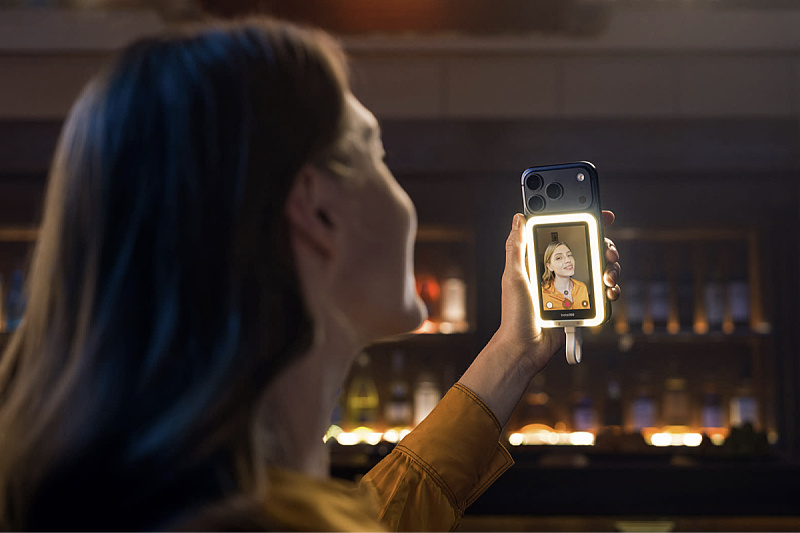
The 3.5-inch touchscreen allows for camera settings adjustments such as zooming and focusing, as well as framing selfies before the user captures them. The company also introduced a model developed in collaboration with the beauty brand AMIRO, which features built-in lighting with multiple color temperatures and brightness levels. The standard Snap costs $79.99, while the version with lighting requires $89.99.
This is not an entirely new product on the market, but Insta360 claims that their USB-C solution offers more stable and lower latency performance.
The Snap screen has a thickness of 6.8 mm; it is slightly thinner than the iPhone 17 and magnetically attaches to the back of MagSafe-compatible iPhones. Insta360 notes that the packaging includes a magnetic ring for other devices and that Snap supports Android phones offering DisplayPort Alt Mode for screen mirroring. The company added that Snap is compatible with all major third-party camera and social media apps to make recording and posting easier.
Phones like the iPhone 17 and Galaxy S25 have rear cameras that offer approximately three to five times the resolution of front cameras, or in the case of the Galaxy S25 Ultra, about 16 times more. Therefore, unless smartphone manufacturers start investing more in front cameras, Snap could become popular among creators and social media enthusiasts.