Speaking about U.S. military activities, Hegseth confirmed that the targets included the strategically important island of Hark, which is a key point for Iranian oil exports. "We had specific military objectives on Hark, which was a clear message. They cannot defend it, and the Iranians ultimately understood their position and their future," said Hegseth. According to him, Iran's ability to produce and export energy was directly under the control of the U.S. and President Donald Trump. "Their ability to produce energy and fund the regime was in our hands. It was in President Trump's hands. That is why they came to the negotiating table," he stated. He added that the U.S. administration made it clear to Tehran that it could completely block their energy sector. "We can take everything from you. Your ability to export energy can be shut down, and the U.S. military has the capacity to strike those targets without any limitations," said Hegseth, emphasizing that it was precisely such pressure that led Iran to agree to a deal. Speaking about Iran's nuclear program, Hegseth expressed extremely tough stances, stressing that the U.S. will not tolerate the existence of enriched uranium outside of control. "They will hand it over to us, voluntarily, as the president stated, or we will take it. We will take it and remove it," he said, adding that the military option remains on the table. "If necessary, we will do it ourselves, as we did in Operation 'Midnight Hammer' or something similar. That option remains open," he conveyed. Hegseth emphasized that the U.S. military presence will remain active to ensure compliance with any potential ceasefire and future agreement. "We will remain present. We are not going anywhere. We will ensure that Iran respects the ceasefire and ultimately comes to the negotiating table and reaches an agreement," he said. In his address, he also touched on U.S. allies, with the message that they could see the real military power of the U.S. "Our so-called allies saw what real capability looks like. They should draw certain lessons," he noted. He added that the U.S. military apparatus, which he called the "War Department," has fulfilled its role but remains ready for further action. "For now, we have done our part. We remain ready in the background to ensure that Iran respects every reasonable condition," he said, with a message of support for the soldiers involved in the operation he called "Epic Fury." Hegseth also claimed that Iran suffered a serious political and psychological blow. "The Iranians are humiliated and demoralized. We control their destiny, not they ours. That is why they came to the negotiating table," he said. He emphasized that the agreement, in his words, means the end of Iran's nuclear ambitions. "They know that this agreement means they will never, ever possess nuclear weapons. Any nuclear material they should not have will be removed," he stated, adding that Iranian facilities are under constant surveillance. "Those facilities are deeply entrenched, but they are under constant surveillance 24 hours a day," he said. Hegseth also highlighted that President Donald Trump had the ability to destroy Iran's economy in a short period but chose a different approach. "Trump had the power to destroy Iran's entire economy in a few minutes, but he chose mercy," he said. Finally, he conveyed that Iran, according to his claims, no longer has the capacity to develop military technology. "They can no longer build missiles, launchers, drones, or develop similar systems," concluded Hegseth.
Society
Hegseth "declared victory": Iranians are humiliated and demoralized, their fate is in our hands.
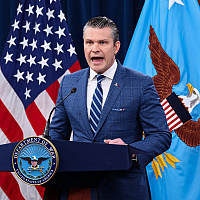
U.S. Secretary of Defense Pete Hegseth delivered a series of sharp messages regarding Iran, asserting that the United States is militarily and strategically overwhelmingly superior, and that it is precisely such pressure that has forced Tehran to the negotiating table.
ingestion