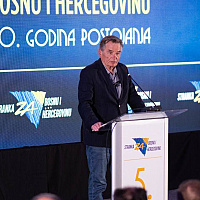
He placed particular focus on the historical opportunities for the country's economic development, which, according to him, were deliberately sabotaged.
During his address, Silajdžić presented the thesis that the domestic public sphere has for years emphasized the narrative of the "April Package" to push the real reason for Bosnia and Herzegovina's economic stagnation into oblivion: the failure of a historic energy project.
"The April Package as a smokescreen."
"Unfortunately, one major project did not go through. These are the energy projects. A project so well concealed. They talk about the April Package so they wouldn't talk about this project. The project was worth three and a half billion marks at the time," emphasized Silajdžić before the attending party members and supporters.
Reflecting on the infamous April Package, Silajdžić highlighted that it is a topic many speak about from memory, without any substantial understanding of the subject.
"I hope people will admit they were wrong about the April Package if they ever read it properly. Those who talk about it, believe me, even admit it; even law professors have admitted to me they never read it, yet they speak about it," said the founder of SBiH.
"Bosnia and Herzegovina's Second Industrial Growth"
At the heart of Silajdžić's presentation was the ill-fated energy megaproject, which involved the construction of new hydro and thermal power units. It was an investment by German investors that was entirely ready for implementation.
The plan was exceptionally favorable for the state: investors would recoup their invested funds solely through the supplied electricity, while all constructed facilities and plants would remain 100% owned by Elektroprivreda BiH from day one.
At that time, the backbone of the Government of the Federation of BiH consisted of SDA and the Party for BiH. However, when this historic agreement was supposed to receive final approval, the project was voted down in the Parliament of the Federation of BiH, through the combined votes of representatives from the Party of Democratic Action (SDA) and the Social Democratic Party (SDP).
"A completed project, the investors wanted to come, it fell in the Federal Parliament to the great delight of those who brought it down, unfortunately," recalled Silajdžić, adding what consequences this had for the country: "That major project would certainly have changed Bosnia and Herzegovina. It would have been a second industrial growth, opening new opportunities both domestically and abroad. We would have had all that. We must contribute to the maturation of this electoral body because that rejection was a reflection of immaturity and a readiness for manipulation."
Besides recalling the energy projects, Silajdžić expressed strong support for the current party president, Semir Efendić, as a candidate for the Presidency of BiH, emphasizing that he "proves through his results that he knows how to work and is not corrupt," which represents the legacy and tradition of this party.
In conclusion, Silajdžić praised the current course of the Party for BiH, which recently refused to participate in the government due to unwillingness to accept political compromises detrimental to the state.
"I am glad that this party has remained on that path, showing that the state is above participation in government. For the first time in modern Bosnia and Herzegovina, a party did not enter the government, although it could have, solely because it adhered to principles. This should be emphasized to people across Bosnia and Herzegovina," concluded Silajdžić.
What did the energy project entail?
It was one of the most ambitious post-war plans for the development of the energy sector in BiH, with an initial value estimated at about 3.5 to 4 billion KM (with long-term expansion plans up to 6 billion).
The focus was on hydro and thermal power units. Specifically, the construction of capital facilities such as Block 7 at the Tuzla Thermal Power Plant, new blocks at the Kakanj Thermal Power Plant, a completely new Bugojno Thermal Power Plant with a mine, and hydroelectric plants like the Vranduk and Unac Hydroelectric Plants were planned.
Instead of launching classic international tenders for construction, the Ministry chose the model of seeking "strategic partners." The most prominent name among the selected companies was the large German state-owned company EnBW (Energie Baden-Württemberg). Besides them, Austrian APET and Kazakh KazTransGas were also in play.
The model was designed so that foreign investors would bring capital and build the facilities, and the state would repay their investment through a concessionary supply of part of the produced electricity over a certain number of years. After repayment, BiH would remain the owner of modern energy infrastructure.
The political breakdown occurred in the Parliament of the Federation of BiH, and the key role in rejecting this project was played by the combined votes of SDA (which at the time formed the ruling coalition with the Party for BiH) and SDP (which was then in opposition).
Why the project was rejected
SDA and SDP representatives sharply criticized Vahid Hećo and the Party for BiH over procedures. Their main argument was that the selection of EnBW and other partners was done non-transparently, in closed circles, and that direct agreements circumvented the Public Procurement Law. At the time, SDP criticized the process, and the then structures believed it involved the sale of state resources, warning of possible severe legal and financial consequences for the state due to such contracts.
The Federal Parliament refused to confirm such a selection of strategic partners, thereby nullifying the entire model. The Germans (EnBW) and other investors subsequently withdrew from the project. Elektroprivreda BiH later spent years trying to build Block 7 on its own (with loans from Chinese banks), which also ended in failure and contract termination a decade later.