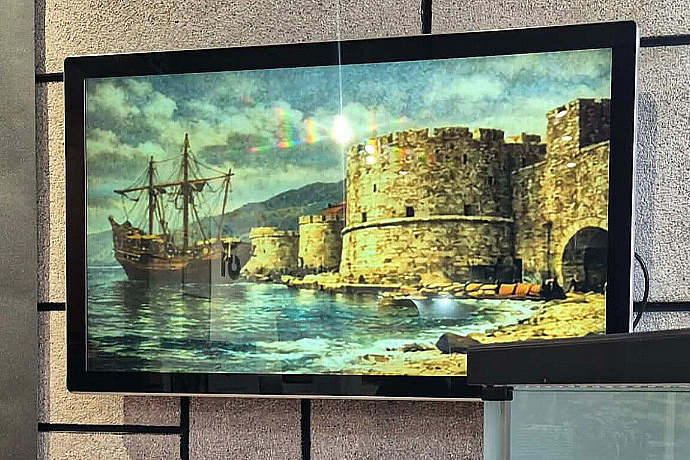
A 1376 trade record from Dubrovnik is a significant piece of historical material that speaks about Goražde today more than ever before. Within a few lines about goods, debts, and trade relations lies proof that this area was already a developed center at that time—a city that traded, followed trends, and was part of European currents, simultaneously at the crossroads of routes, cultures, and ideas.
"Today, the documents that attract the most attention are those found in the Dubrovnik archive, which we obtained here with translations thanks to our colleague Enes Dedić. They speak about merchants from Goražde who traveled to Dubrovnik and returned to Goražde with various goods. They mention the quantity of goods they brought, the items they carried, which goods they left behind, and which they brought here. These are very interesting items, of which there aren't many, but they speak about the rich life during the 14th and 15th centuries in the area of Goražde," emphasizes Admir Džemidžić, director of the Archive of BPK Goražde.
These records also reveal the business methods of medieval merchants, and Džemidžić points out that merchants would take on debt in Dubrovnik, about which there are specific documents. Interestingly, the exhibition also brings details that surprise and change the perception of the past, such as those about fashion.
"For example, Ottoman fashion arrived in the area of Goražde before the Ottomans themselves, and there are several contracts ordering dresses made in the Ottoman style to be sent here to Goražde. This is a particularly interesting fact because a hundred years would pass from that period before the Ottomans arrived in these areas. Some of our wealthier citizens certainly ordered them; we know about the Zlatarić family who lived here and were engaged in jewelry making," recounted Džemidžić.
On the other hand, Goražde at that time was not only a buyer but also an exporter.
"Today, for example, we are a strong beekeeping region, but back then we were even stronger because our wax went to Italy and later to France, where it was used in courts for making candles; it was highly valued. Also, the hides from our game were highly prized. We had a certain quality that we could showcase to that Central European culture, which in some parts was at a higher level of development compared to Goražde. However, some stronger cities in Bosnia, such as Bobovac, Visoko, and others, did not lag far behind that Central European culture," says Džemidžić.
In addition to documents, the exhibition brings valuable archaeological finds.
"There are very interesting items, of which, admittedly, there aren't many, but they speak about the rich life during the 14th and 15th centuries. Among them are arrows, craft tools, and forged nails, but also particularly valuable finds, such as a winged spear found by our fellow citizen Armin Čavrk and donated to the museum, and a very rare vessel believed to date back to the 12th century, found by Edhem Džino and gladly donated to the museum. There are also other items found by our fellow citizens, such as Admir Adilović," he emphasizes.
He adds that this gives special value to the exhibition because citizens have shown awareness of the importance of preserving heritage. The exhibition is the result of broader cooperation and a modern approach to presentation.
"The combination of documents, objects, and multimedia expressive means, and our designer Mehmed Bajrović put a lot of effort into this exhibition," explains Džemidžić, also highlighting the importance of the cantonal government's support.
The exhibition was opened by the director of the Cultural Center, Jasmin Bešlija, emphasizing its broader significance.
"This exhibition is not just a reminder of a historical moment but an opportunity to understand more deeply the roots of our city, its identity, and its endurance through time. Special value is added by the fact that it is the result of institutional cooperation, confirming how crucial joint action is for preserving heritage. A people who know their history can confidently build the future," he conveyed.
That the exhibition has special significance for citizens is also confirmed by visitors' reactions.
"I am happy to be able to attend such an exhibition and that something like this is happening in our city. I haven't had the opportunity to learn about history in this way, and this is a wonderful way to get acquainted with our roots," said one of the visitors.
The exhibition will remain open during the summer months because the story it tells lasts much longer.