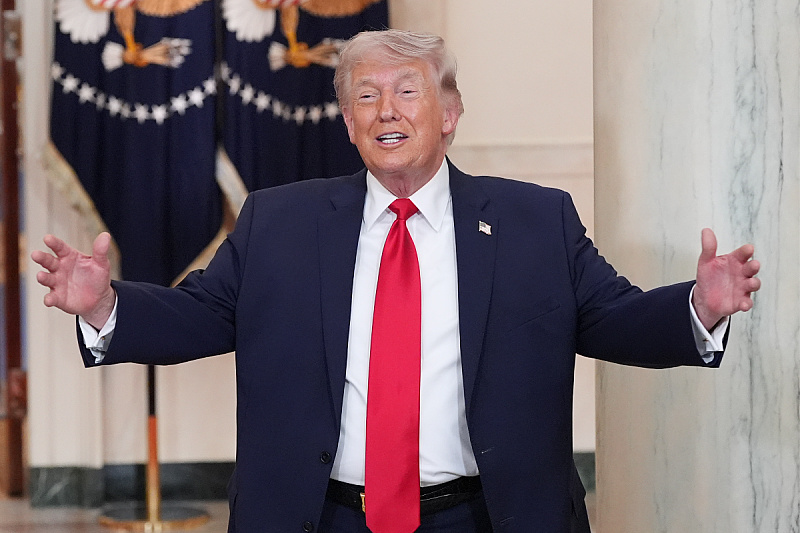
In his prime-time address, Trump notably omitted his oft-repeated claim that negotiations with Iran are ongoing. He toned down insults toward NATO allies and gave no indication of preparing to deploy ground troops, particularly not to seize Iran’s enriched uranium. However, he also did not offer a definitive timeline for ending the conflict.
The war is rapidly becoming a hallmark of his second-term agenda, and the speech served as a kind of climax to an extraordinary day of presidential power projection. Trump began the morning as the first sitting president to appear before the U.S. Supreme Court, a stunning encroachment of executive power into the judicial branch. He ended the day with his White House address on a war he initiated unilaterally, bypassing Congress.
On a night when many Americans may have been gazing at the sky as the Artemis II astronauts launched in NASA’s return to the Moon, Trump briefly acknowledged that historic moment. He then quickly refocused on himself and the conflict with Iran, which has claimed over a dozen American military lives and appears to have no easy exit.
"America, as it has been for the five years of my presidency, is winning—and now winning more than ever before. We will finish the job, and we will finish it very quickly," Trump declared.
The president stated he wanted to "talk about why Operation Epic Fury is necessary for the security of America and the free world." His aim was to show that one purpose of Wednesday’s address was to clear up ongoing confusion as the administration shifts its rationale for launching the war.
Yet, over nearly 20 minutes of speaking, Trump offered no new explanations. He reiterated that Iran cannot have nuclear weapons, calling such a prospect an "intolerable threat," and claimed the country is building a vast arsenal of ballistic missiles that threaten U.S. territory.
While he said Iran’s ballistic missile capability has been significantly degraded, he did not explain how the operation has halted Iran’s nuclear ambitions. He and his administration have previously insisted that U.S. and Israeli strikes last summer "destroyed" Iran’s nuclear program.
Though he broadly portrayed threats from Iran as eliminated, Trump provided no evidence for that assertion, especially considering multiple rival power centers continue to operate within Iran’s theocracy.
Iran has long claimed its nuclear program is peaceful. Still, it has enriched uranium to 60% purity—a short, technical step away from weapons-grade levels. Before the war, U.S. intelligence agencies assessed that Iran had not yet begun a nuclear weapons program but had "undertaken activities that better position it to produce a nuclear device if it chooses to do so."
Thousands of additional U.S. troops are heading to the Middle East. Gulf allies are urging Trump to finish the fight, arguing Tehran has not been sufficiently weakened.
However, Trump predicted days ago that the U.S. would be done "maybe in two weeks." On Wednesday, he said the U.S. would hit Iran "extremely hard over the next two to three weeks." Oil prices rose afterward.
He stated that "core strategic objectives are nearing completion" and signaled no preparations for a ground invasion by U.S. troops, whether to seize Iran’s enriched uranium or to secure the Strait of Hormuz, where Iran’s tightening grip is driving up energy prices.
Moreover, he said nuclear sites bombed last year would now be difficult for Iran to reactivate and that the U.S. is monitoring them via satellite. "If we see them take any move, even start to move toward it, we will hit them with missiles very hard," he warned.
Trump is rapidly approaching the 60-day mark after which, under the War Powers Act, he must seek congressional authorization to continue any military operations. He did not speak of any diplomatic efforts to achieve a ceasefire, leaving the impression the war will end when the U.S. finishes striking targets. After days of Trump asserting that positive talks with Iran were underway, the absence of that topic was conspicuous. Iran has denied any negotiations are taking place.
Though earlier in the week he blasted NATO allies and other U.S. partners with a barrage of insults for not participating in the conflict—including several direct threats to withdraw from NATO—this time Trump was unusually restrained. He did not mention NATO at all and only stated that countries most dependent on global oil shipments, which typically transit the Strait of Hormuz, must take the lead in protecting that key maritime route once the war ends.
"The countries of the world that get oil through the Strait of Hormuz need to care about that passage. They need to value it. They need to take it over and value it," he said.
Trump said those countries should "summon some belated courage" but did not name any allies as he has done before. "Go into the strait and just take it over. The hard part is done, so that should be easy," he added.
Trump, who campaigned as an "America First" president promising not to drag the country into endless wars, has yet to face serious political backlash over the Iran war from within his own base.
Most explicitly to date, he acknowledged that many Americans are worried about fuel prices, calling them "short-term increases." Still, he insisted the U.S. has become "the hottest country anywhere in the world," and that Americans are benefiting from what he called the "great, beautiful bill" he signed last year.
In reality, the U.S. economy is shaky, financial markets are reacting sharply to his various war statements—including after the address—and Americans are feeling the pinch at gas pumps as living costs rise.
He offered no new measures to address economic concerns, instead trying to convince people this is a price to pay for a better future. He recalled the long wars in Korea and Vietnam and promised the U.S. would ultimately be in a better position because of this war.
"This is a real investment in the future of your children and grandchildren," he asserted.