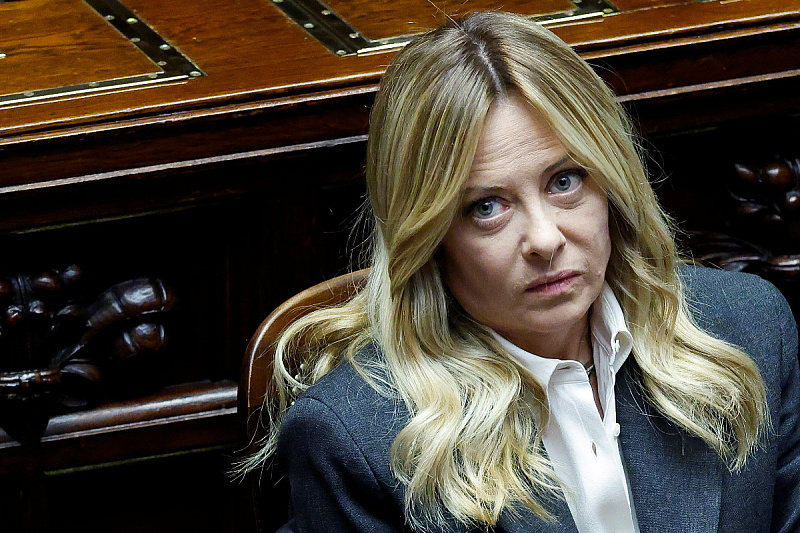
"The West stands on two legs: the European and the American. If they do not move in the same direction, there is a risk of paralysis," warned Meloni, adding that she still believes in "the need to work to preserve Western unity."
This speech comes after the government lost a referendum on judicial reform, which many saw as a vote on Meloni herself. Her allies attribute the defeat to rising energy prices caused by the war in Iran, as well as her friendship with Trump, which is increasingly seen as politically toxic even on the right.
In her address, the right-leaning prime minister publicly highlighted disagreements with the American leader for the first time since Trump's re-election in 2024.
"As is normal among allies, we must clearly state when we disagree," Meloni said in parliament.
She then pointed to examples where, she claims, her government did not follow the White House's positions.
She cited tariffs, which she called a wrong decision, as well as the defense of Italian soldiers in Afghanistan, whom Trump described as "useless." She also highlighted the example of joint action on Greenland.
"The war in Iran is a military operation in which Italy did not participate and with which it did not agree, as became clear in its full concreteness through the Sigonella case," said Meloni.
This marks the first time she has publicly addressed Italy's recent decision to deny a U.S. military aircraft permission to land at the Sigonella base in Sicily before flying to the Middle East.
These statements represent a clear rhetorical shift from her alliance with Trump, who is highly unpopular in Italy, compared to her milder stances earlier this year.
Meloni had previously called Trump's tariffs on European countries that sent troops to Greenland a mistake but also justified that decision as a result of misunderstandings. She also supported the idea of awarding Trump the Nobel Peace Prize.
However, the sharp rise in energy prices linked to the Middle East conflict is becoming particularly politically dangerous.
A Bank of Italy report released on Friday revised growth forecasts downward due to exceptionally high uncertainty, implying that the impact of the war in Iran on Italy's energy market and economy could lead to a recession.
These constraints make it difficult for the government to find funds for the last budget before next year's elections and to increase citizens' purchasing power.
In this context, Meloni reiterated in her speech a proposal from her ministers, previously rejected by the European Commission, to temporarily suspend the Stability and Growth Pact if the conflict continues.
Deputy Prime Minister Matteo Salvini said on Wednesday that suspending the pact is a government priority and compared EU fiscal rules to a "straitjacket."
European officials have also begun signaling greater openness to the idea. European Commissioner Stéphane Séjourné stated that the Union does not rule out greater flexibility in light of the crisis.