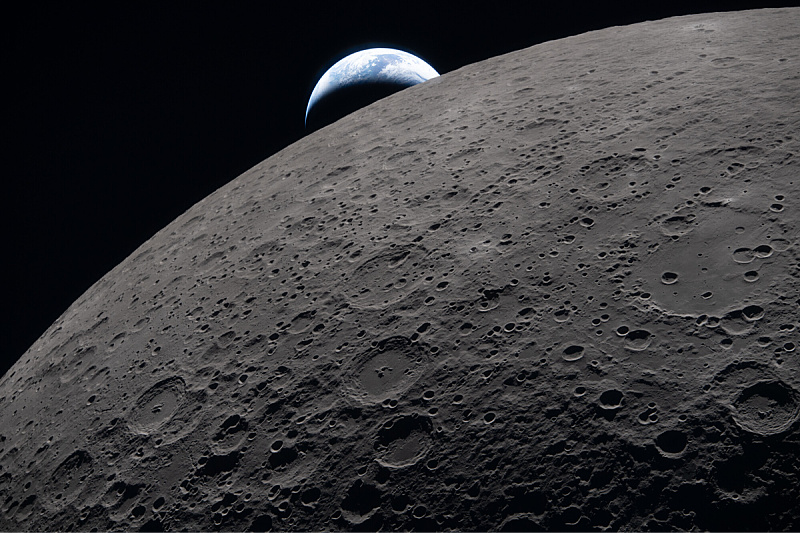
For the first time in history, humans have fully witnessed the far side of the Moon with their own eyes, and the first photographs from this incredible endeavor are already breathtaking. At the most anticipated moment of the mission, the crew spent about seven hours orbiting the Moon. Through the windows of the Orion spacecraft, NASA astronauts Reid Wiseman, Victor Glover, and Christina Koch, along with Canadian astronaut Jeremy Hansen, captured numerous images of the rugged lunar terrain, vast impact craters, and endless dark plains.
"Earthset" and a Historic Solar Eclipse The first photograph was shared by the White House on platform X, depicting the so-called "Earthset"—a mesmerizing moment captured from the far side of the Moon as our planet slowly disappeared from view. This image serves as a kind of inverted recreation of the iconic "Earthrise" photograph from the Apollo 8 mission in 1968, when Earth appeared to rise from behind the Moon. A spectacular photograph of a solar eclipse taken by the astronauts from space was also shared. They became the first humans to observe a solar eclipse from the Moon. The image shows the Moon completely darkened, with the Sun's corona mystically glowing around its edges.
The Magic of the "Terminator" and Record-Breaking The crew members were captivated for hours by the views, colors, and lighting of the Moon up close, even reporting brown and green hues on its surface. Astronaut Glover was particularly fascinated by the lunar "terminator," the dividing line between the illuminated side of the Moon and the side shrouded in darkness, where sunlight at a low angle creates dramatic shadows. "There’s so much magic in that terminator—islands of light, valleys that look like black holes. You’d fall right into the center of the Moon if you stepped into some of them. Visually, it’s absolutely stunning," Glover emotionally reported to Mission Control in Houston. One of the main scientific targets of the mission was the Orientale Basin, an impact crater nearly 1,000 kilometers wide, stretching across both sides of the Moon and formed 3.8 billion years ago. On the other hand, astronaut Koch described newer, smaller craters, noting how incredibly bright they were: "They look like a lampshade with tiny needle holes."
During this flyby, the Artemis II mission crew also set a new absolute record. While passing around the Moon, they reached an incredible distance of 406,771 kilometers from our planet, breaking the record set by the astronauts of the famous Apollo 13 mission in 1970 by more than 6,500 kilometers. "When we have this perspective and compare it to our home, Earth, it reminds us how much we have in common. Earth provides everything we need. And that’s a kind of miracle you can’t truly grasp until you gain perspective from the other side," Koch shared.
NASA plans to release the full gallery of high-resolution photographs only after the crew returns to Earth, due to data transmission limitations from deep space. The heroic quartet is currently on their way home, with their re-entry into Earth’s atmosphere and splashdown in the Pacific Ocean near San Diego scheduled for Friday.