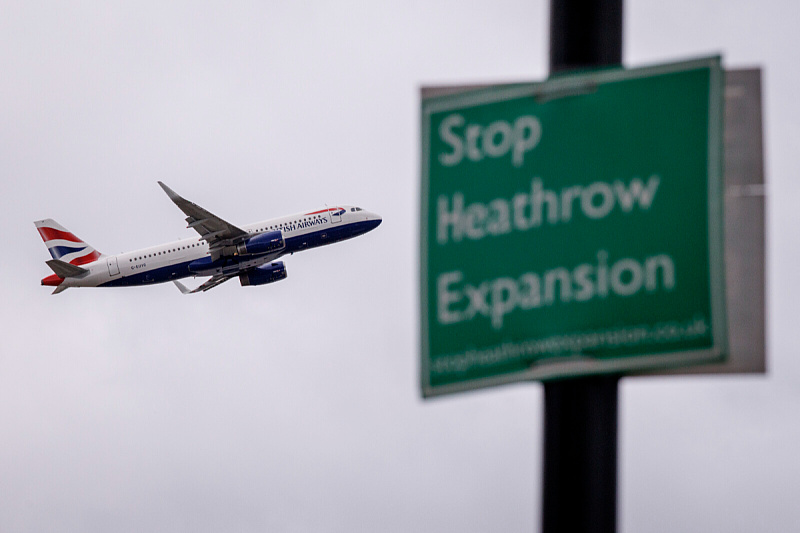
The most at risk are London's Heathrow Airport and other British airports, which are already canceling flights due to fuel shortages. Specifically, the regional airline Skybus has discontinued one route because of high fuel prices.
According to estimates by the Belgian analytics company Kpler, French airports could be next in line. "Our assessment is that France is next with the largest supply deficit relative to demand, after the United Kingdom," stated George Shaw, a senior oil analyst at Kpler.
However, as he noted, France is in a good position to secure additional fuel from sources outside the Persian Gulf.
Before the U.S.-Israeli attack on Iran, and prior to the Strait's closure, one-fifth of the world's crude oil reserves were transported through the Strait of Hormuz.
The specialized publication Argus reported that the price of kerosene in Europe today reached a record $1,900 (3,230 KM) per metric ton (one metric ton equals 1,250 liters).
European airports currently have enough fuel to maintain flights, but, as mentioned in the publication, shortages are possible in the near future.
Portugal could run out of kerosene in four months, Hungary in five months, Denmark in six months, Italy and Germany in seven months, and France and Ireland in eight months.
Poland is the only self-sufficient producer of kerosene, making it unlikely to run out of this fuel.
Even before the conflict in the Middle East, airlines warned that they were facing a structural deficit of kerosene, partly due to Western sanctions on Russia and reduced capacity at European refineries. European kerosene production relies on crude oil imports, mainly from the Middle East.
Airlines are struggling to save kerosene because, due to the conflict in the Middle East, they are forced to fly longer routes—longer routes mean higher kerosene consumption. Specifically, according to data from the European Organization for the Safety of Air Navigation (Eurocontrol), it is certain that throughout the entire summer, 1,150 flights will be rerouted daily, as long as the conflict remains as it is.
Airports and airlines are additionally concerned by the announcement from U.S. President Donald Trump that attacks on Iran will be even more intense, writes the foreign policy portal Politico.