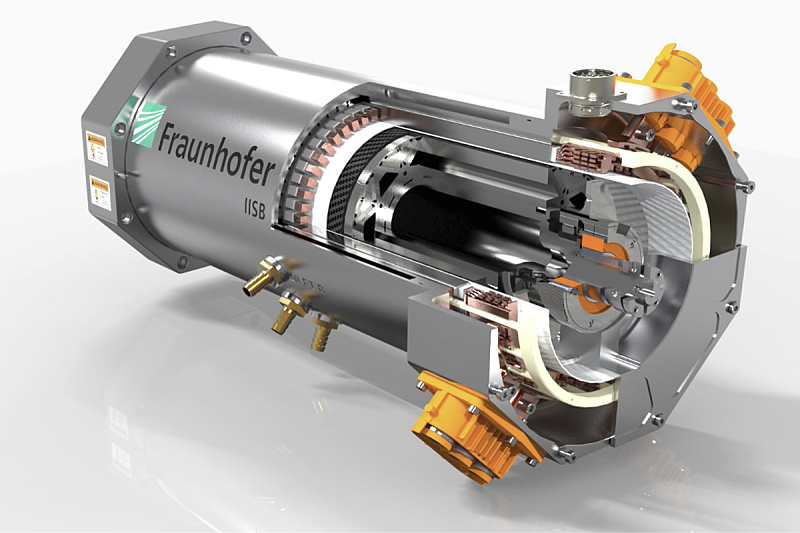
The new motor weighs only 94 kg, which is crucial for aviation because every additional kilogram reduces range and increases fuel consumption. Every effort to reduce weight, where possible, is key to an aircraft's power-to-weight ratio.
For this purpose, the new motor can achieve a ratio of 8 kW per kilogram, which is exceptionally good for aircraft electric motors. To put that into perspective, a typical electric motor usually delivers between 2 and 4 kW/kg, while more advanced aircraft motors range between 5 and 6 kW/kg.
At 8 kW/kg, this new motor appears truly impressive. Its recorded power of 1,000 horsepower is also impressive, as it is roughly equivalent to a small turboprop aircraft engine.
This would be sufficient to power a regional aircraft, similar to the engines on small passenger planes. However, this new motor is smaller, lighter, and fully electric, which is its unique advantage.
This was achieved by using something called "hairpin windings" instead of more traditional methods like copper wire. By employing 4×3-phase hairpin windings, the new motor can accommodate more copper in the same space.
This means it can generate higher current, leading to greater power. It also provides better cooling and is mechanically stronger. The motor is also directly cooled by oil spray, which is another major innovation.
Thus, instead of relying on air cooling, the use of oil helps remove heat faster, enabling higher power without overheating. This, in turn, helps reduce the motor's size, which is excellent for applications like aircraft.
Another major innovation is the use of ultra-thin NO15 steel (0.15 mm) in the motor. This is about half the thickness used by most electric motors. This is crucial because the thinner the metal used, the fewer eddy currents are produced.
This, in turn, generates less heat and ultimately makes the motor much more efficient. This is particularly important at higher speeds, as the new motor can produce around 21,000 revolutions per minute.
Another interesting part of the motor is its declared fault tolerance. According to the team, the motor consists of four independent sections.
Since each section has its own winding system, inverter, and control, this means that if one fails for any reason, the motor can still operate. In the air, this is critical, as it means the aircraft will not completely lose power if something goes wrong.
The new motor was developed as part of the European Union's "clean aviation" goal under the name Project AMBER. This project aims to promote technologies such as hydrogen fuel cells and hybrid turbine aircraft, with the ultimate hope of reducing aviation CO2 emissions by 30 percent or more.
The project envisions a hydrogen fuel cell to provide electricity, which in turn is used to power an electric motor on the propeller. Such aircraft could also use turboprop engines as backup when needed.
There is hope that the project will lead to cleaner, quieter, and far more economical aircraft.