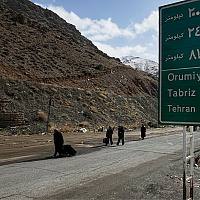
On the 12-hour drive south toward the capital Tehran, life mostly goes on as usual, with only occasional traces of the ongoing war, including a Shiite religious center that officials say was damaged in a recent airstrike.
Associated Press journalists embarked on the journey Saturday after entering Iran from Turkey. Along the way, they gained insight into a country at the epicenter of a regional war that is shaking the global economy and shows no signs of abating five weeks after Hamnei was killed in an initial U.S.-Israeli strike.
The Iranian government allowed AP to send an additional team into the country for a short reporting trip. AP already has a crew in Iran. The visiting team must be accompanied by a handler from a government-linked firm, but AP retains full editorial control over its content.
The first major sign of war damage appears in the northwestern city of Zanjan, about six hours from the border.
Iranian officials say an airstrike hit a religious and social center, known as a husseiniya, killing two people and destroying a clinic and library. Other parts of the complex, some centuries old, were also damaged, including its golden dome.
When asked about the attack, the Israeli military said it targeted a "military headquarters" and strives to avoid civilian sites, offering no further details.
"It hit me hard and deeply saddened me," says local resident Somayeh Shojaei, who attended religious and cultural events at the center. "With these airstrikes, (the U.S. and Israel) are showing their evil intentions to the whole world," she added.
A librarian and a volunteer for the Iranian Red Crescent, a first-responder organization, were killed in the attack, says Jaafar Mohammadi, provincial director for culture and Islamic guidance.
According to him, the clinic provided free healthcare to the poor, and students relied on the library, which housed over 35,000 books, including ancient manuscripts.
He says he does not know why the complex was targeted.
"Iran wanted to negotiate peace with (U.S. President Donald) Trump, but Trump responded with war," says Mohammadi. "He started the war, but we will surely be the winning side."
The U.S. and Israel have carried out thousands of strikes across the country, and Trump has threatened to bomb Iran "back to the Stone Ages, where they belong." Over the weekend, he reiterated a Monday deadline for Iran to reopen the Strait of Hormuz, a key oil and gas shipping route.
Remaining Iranian leaders remain defiant and firmly in power, rejecting what they call unreasonable U.S. peace proposals. Israel shows no signs of planning to slow attacks and calls on Iranians to overthrow their leaders.
While the war causes global tremors, as well as fear and uncertainty within the country, daily life continues.
From city to city on the road to Tehran, AP journalists saw normal traffic, open shops, and people on the streets. In one restaurant, Iranian specialties like grilled lamb and rice, barley soup, and saffron drinks were served, while R.E.M.'s song "Losing My Religion" played from the speakers.
Many women were seen carrying out daily tasks without the mandatory headscarf, which is prescribed by the theocratic regime but whose enforcement has relaxed in recent years.
On the approach to Tehran, the team passed two checkpoints without being stopped.
The city was unusually quiet after midnight. The night before, heavy airstrikes hit the mountains above the capital.
Tehran is on the front line, having endured waves of attacks that the U.S. and Israel say target the military and internal security forces. Iranian authorities say over 1,900 people have been killed so far. It is unknown how many are soldiers and how many are civilians.
AP journalists saw several destroyed government buildings and police stations. They passed numerous checkpoints manned by plainclothes Basij members, internal security forces, and uniformed paramilitary Revolutionary Guards.
Once, they were stopped and asked to open the car and show press credentials, after which they were allowed to proceed.
Fuel is heavily subsidized, so a gallon (about four liters) of gasoline costs approximately 15 U.S. cents. However, citizens can only buy about five gallons (20 liters) at a time. There were no lines at the pumps.
In Zanjan, Mahmoud Maasoumi, a retired soldier, says the conflict with the U.S. — "global arrogance" — dates back to the 1953 coup that, with CIA support, overthrew the Iranian prime minister and is deeply etched in the collective memory of many Iranians. He hopes Iranian leaders will defend the country.
"The enemy sees that we never give up," he says.