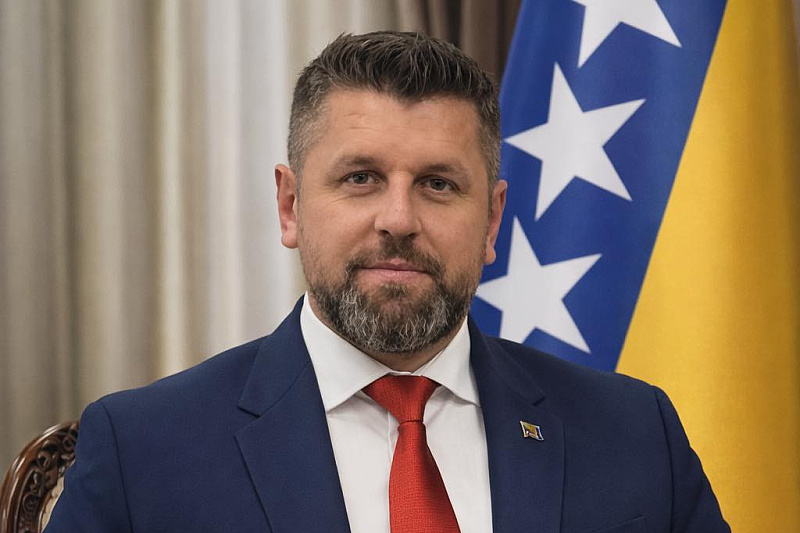
"This is a systemic legal solution that for the first time clearly and precisely regulates the minimum political representation in local self-government units where a specific constituent people or Others constitute between 1% and 20% of the population, based on the 2013 Population Census. The law introduces special electoral lists and a guaranteed number of mandates for Bosniaks, Croats, and Others in communities where they are currently insufficiently or not at all represented in local assemblies," explained Duraković.
He emphasizes that this is not about privilege, but about the constitutional minimum of political equality: "This is not a law against anyone, but a law that introduces a minimum of fairness where it objectively does not exist today. Representation must be a matter of system, not goodwill."
He points out that local democracy cannot be stable if a significant part of the population remains permanently excluded from decision-making: "In many municipalities, people exist statistically, but they do not exist politically. This law changes that and restores the meaning of local assemblies as representative bodies of all citizens."
Duraković particularly emphasizes the political dimension of the initiative in the context of the next electoral cycle. "We demand that the adoption of this law be one of the clear and measurable conditions for forming the government after the 2026 elections. Whoever wants to participate in the government must show readiness to protect constitutional equality and put such a regulation into practice by the local elections in 2028," he said.
At the same time, he supports that an identical legal solution be proposed in the Federation of Bosnia and Herzegovina, to ensure an equal standard of political participation across the entire territory of the state. "Equality must not depend on the entity. If we believe in equality as a principle, then it must apply in both entities and in the same way," said Duraković.
For Bosniaks, the law would mean guaranteed minimum representation in several local self-government units, depending on the percentage share according to the 2013 Population Census. At least one councilor seat would be ensured in Šekovići, Mrkonjić Grad, Srbac, Kalinovik, Čelinac, Trebinje, Istočni Stari Grad, Nevesinje, Gacko, Banja Luka, Kneževo, Istočna Ilidža, and Sokolac.
At least two councilor seats would be guaranteed in Šipovo, Foča (RS), Derventa, Šamac, Berkovići, Prnjavor, Rudo, Ljubinje, Brod, and Višegrad. At least three councilor seats would be ensured in Kozarska Dubica, Rogatica, Modriča, Han Pijesak, Bijeljina, Ugljevik, Gradiška, Čajniče, and Teslić.
For Croats, the law would guarantee at least one councilor seat in Mrkonjić Grad, Trebinje, Istočna Ilidža, Prnjavor, Istočni Drvar, Kozarska Dubica, Kostajnica, Laktaši, Gradiška, Prijedor, Doboj, Banja Luka, Teslić, Istočni Mostar, Oštra Luka, and Kotor Varoš.
At least two councilor seats would be ensured in Modriča and Derventa, while at least three would be guaranteed in Šamac, Vukosavlje, and Brod.
For national minorities and Others, the law would guarantee at least one councilor seat in Prnjavor, Banja Luka, Vukosavlje, Prijedor, Gradiška, Modriča, Laktaši, Istočni Stari Grad, Čelinac, Bileća, Novi Goražde, Foča (RS), Novi Grad, Kotor Varoš, Istočna Ilidža, Šamac, Kostajnica, Kozarska Dubica, Brod, Derventa, Bijeljina, Teslić, Srbac, Istočno Novo Sarajevo, Doboj, Trebinje, and Trnovo (RS).
According to the 2013 Census, there is no local self-government unit in the entity of Republika Srpska where Serbs constitute between 1% and 20% of the population, so the measures of this law in these percentage ranges do not apply to that category.