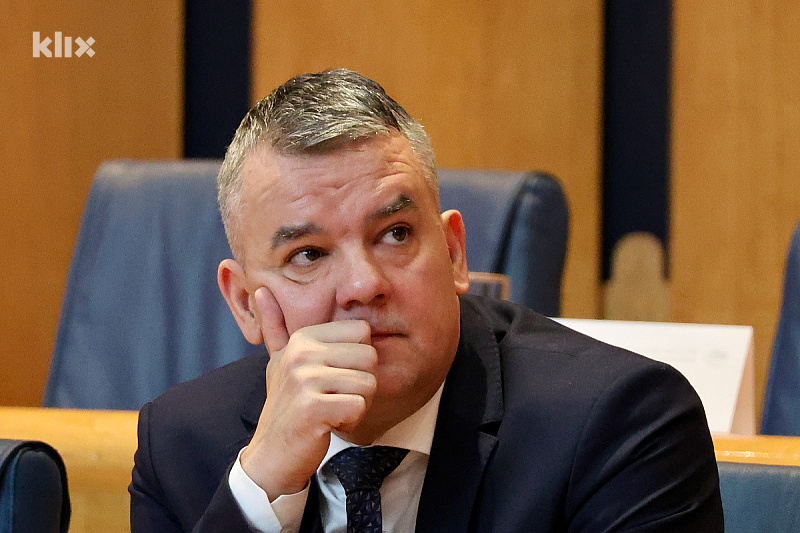
Several months ago, the focus of politicians in Bosnia and Herzegovina was on appointing a chief negotiator, as this is a condition that BiH must fulfill to open negotiations with the European Union. The Council of Ministers attempted to do this at the executive level, but representatives did the same in the House of Representatives of BiH. The decision of the House of Representatives was overturned by the Constitutional Court of BiH, and in addition, the BiH Presidency also protested, stating that foreign policy falls under their jurisdiction.
"Why simple when it can be complicated?" is the title of a post in which Bunoz expresses the opinion that the decision of the Constitutional Court of BiH unnecessarily complicates the process of appointing a chief negotiator by ordering the Parliamentary Assembly of BiH to create a legislative framework for his appointment.
Bunoz, in fact, believes that everything can be legally completed in the Council of Ministers of BiH, and the rare post in English indicates that the Minister of Justice is actually addressing the international community, namely Brussels, which is relevant to accept or reject the decision on BiH's negotiator with the EU.
Indeed, during intensive attempts to appoint a chief negotiator, we unofficially learned that Brussels would accept any decision on the appointment of a chief negotiator agreed upon by officials in BiH, regardless of what legislative framework they would use.
Aware of this, Bunoz is obviously trying to influence Brussels to accept a decision that would be independently made by the Council of Ministers of BiH because, as he says, it is the simplest way. However, the question is whether this would be in accordance with the law, especially after the Constitutional Court of BiH ordered the Parliamentary Assembly to first adopt a legislative framework for the appointment of the chief negotiator, and it is highly likely that the decision of the Council of Ministers would also end up before the Constitutional Court of BiH.
"The European Union's demand towards BiH is not the adoption of legislative acts on the chief negotiator, but the adoption of a decision on the chief negotiator. In a complex state like BiH, something that is essentially simple to resolve and should have already been resolved is further complicated, namely that the Council of Ministers regulates this issue by decision, as competent executive bodies have done in other countries that have or have had open negotiations with the European Union, without prior adoption of special legislative acts related to the chief negotiator. It is clear that the negotiation process with the European Union represents a technical-operational procedure led by the executive authority - the Council of Ministers and competent institutions," wrote Bunoz.
However, it should also be emphasized that the decision on the appointment of the chief negotiator with the EU in countries wishing to join the Union has often been made by the legislative branch, not exclusively the executive.
BiH is already in an election year, and steps towards fulfilling the conditions for opening chapters, i.e., clusters on accession to the European Union, have slowed down. As elections approach, less and less will be able to be done on the ground, and if the current government does not move things from a deadlock, it will be a failure of the government, so in this context, such an interpretation by Minister Bunoz should also be viewed.