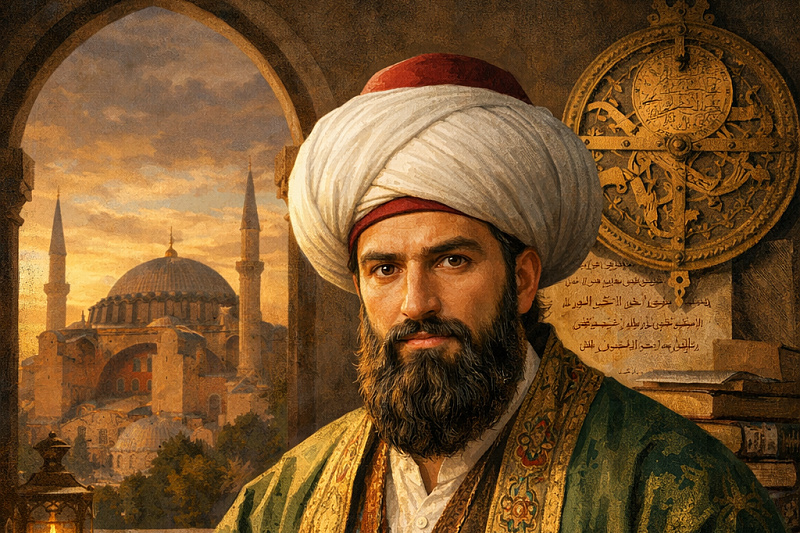
Born around 1595 in Sarajevo, Muhamed Musić gained a reputation as an exceptionally gifted student even as a child. After studying at the Gazi Husrev-beg madrasa, at just 17 years old, he went to Istanbul, then the center of knowledge and power. There, he perfected his skills under renowned scholars, most notably Abdulganizade Nadirija, with whom he spent seven years.
His career developed in three directions: as a professor, writer, and judge. Early on, he taught logic, and the peak of his academic career came in 1633 when he became a muderis at the prestigious Sahn-i Seman madrasa in Istanbul, one of the eight most important educational institutions in the capital of the Ottoman Empire. However, his life was not without challenges.
For Sultan Murad IV's campaign, he wrote a commentary on Surah Al-Fath, and thanks to this, along with the recommendation of Silhadar Mustafa Pasha, he became a judge in Aleppo in 1634.
A rheumatic illness forced him to leave Aleppo, but due to opposition from Mustafa Pasha, he did not return to Istanbul. Instead, he was placed under a form of house arrest in Rumelihisarı. The reason for this was Mustafa Pasha's fear that Allamek would speak about certain illegal activities he had committed in Aleppo. During his stay in Rumelihisarı, he also received an appointment as a judge in Istanbul, but exhausted by illness, Muhammed Musić Allamek died in 1635.
His work is characterized by sharp wit and a willingness to question authority, which was unusual for the time. All his works were written in Arabic; he wrote about logic, law, Quranic exegesis, and Arabic philology. Except for one translation from Arabic to Turkish, all his works are commentaries.
Particularly notable is his work in the field of logic, "Sharh al-Shamsiyya," which provides a detailed analysis of one of the key texts in Islamic philosophy. He also engaged in exegesis, syntax, rhetoric, and administrative matters, as evidenced by his translation of a work on state governance dedicated to Sultan Murad IV.
He left behind a rich body of work in Arabic, now preserved in 12 different libraries. His works testify to an intellectual who did not accept blind obedience to authority but advocated for freedom of thought and a critical approach to knowledge.
Muhammed Musić Allamek remains an example of how a Sarajevan, during the era of great empires, managed to leave a mark in science that still attracts researchers' attention today. His story is not just a historical curiosity but also a reminder of the power of knowledge, ambition, and the courage to think differently. It is yet another story of how now largely forgotten Sarajevans shaped the science and the empire in which they lived.