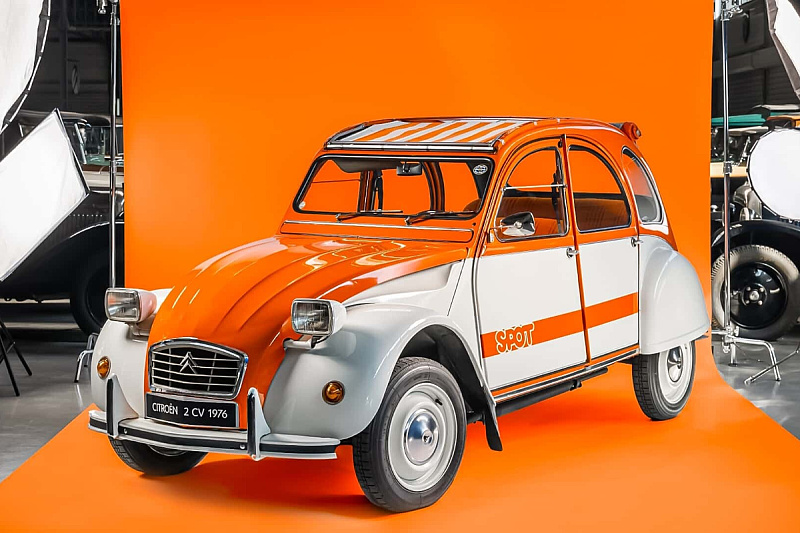
The two-tone 2CV4 Spot was introduced 50 years ago and officially marks the first Citroën model with which the historic French automotive company opened the chapter of special and limited-edition models in 1976.
The story of the "Spot" began in 1974 when renowned graphic designer Serge Gevin presented two design proposals to Citroën's management to refresh the popular 2CV model, whose first edition was unveiled to the public back in 1948.
Of the two proposed designs, Citroën opted for the second (more cheerful) version, giving the then 2CV4 a two-tone bodywork, complemented by a two-tone interior and a matching canvas roof. The combination of Ténéré orange and Meije white was inspired by summer and coastal landscapes.
Two years later, the prototype of the special 2CV4 was photographed on the shores of Normandy. The first units rolled off the production lines at the Levallois factory in February, and the initially suggested name for the limited edition (Transat) was replaced with "Spot." All 1,800 planned units for the French market sold out within a few days, and production ended in late May.
The pioneer of Citroën's special editions was powered by the legendary air-cooled two-cylinder boxer engine A79/1 (435 cc), whose 23 horsepower was sufficient for speeds just over 100 km/h. The Spot was also offered in some European markets with a slightly larger and more powerful "twin flat" engine (602 cc), which powered the 2CV6 and several other "deux chevrons" models. With additional units produced at Citroën's facilities in Belgium, the Spot ultimately saw around 2,500 examples built.