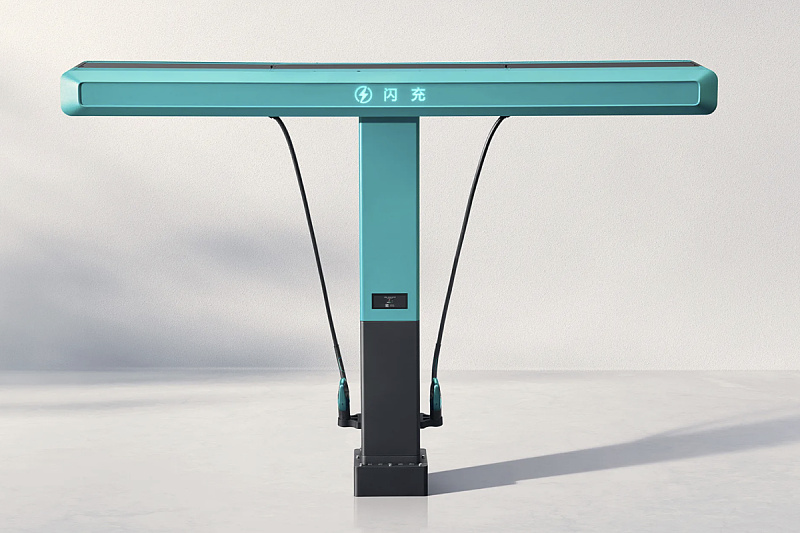
Europe already has thousands of electric vehicle charging stations, but BYD's fast chargers not only surpass today's fastest public chargers, they absolutely outpace them. BYD says the new hardware can deliver up to 1,500 kW, making it the fastest charging system announced for Europe so far.
However, the chargers won't be available only to BYD owners. These chargers use CCS2 connectors and should also be accessible to other brands. Dealers selling BYD's luxury Denza vehicles will get their own branded versions, while public locations elsewhere will simply carry the name Flash. BYD also plans to collaborate with existing charging locations instead of starting from scratch each time.
BYD says their latest battery technology can charge compatible car batteries from 10 to 70 percent in five minutes, and from 10 to 97 percent in nine minutes. That means fewer charging stops and more rest breaks.
The first users of the new chargers in Europe will be the Denza Z9GT and D9 DM-i models. The Z9GT is a dazzling, three-motor, fully electric shooting brake with a 123 kWh battery and enough power to accelerate from 0 to 100 km/h in 2.7 seconds.
Meanwhile, the D9 DM-i minivan proves that plug-in hybrids can join the fun too. Its 58.5 kWh battery can accept up to 559 kW, enabling the same five-minute charge from 10 to 70 percent battery capacity, or a nine-minute charge from 10 to 97 percent. This is especially practical in a huge seven-seat MPV with an electric range of 209 km, or a total range of 950 km when the gasoline tank is full. In contrast, some plug-in hybrids from other brands still don't support DC charging at all.
Of course, BYD isn't the only one making progress. Geely claims their latest chargers and Golden Brick battery technology are even faster.
However, BMW doesn't believe in the hype.
"You always have to be cautious with such announcements," the company's head of battery production, Markus Fallböhmer, recently told Car Sales, suggesting that battery longevity and reliability could be compromised.
"It's possible to optimize one performance indicator, but you have to make compromises on other sides. We could also increase charging speed, but then you have to reduce other important battery factors," Fallböhmer concluded.