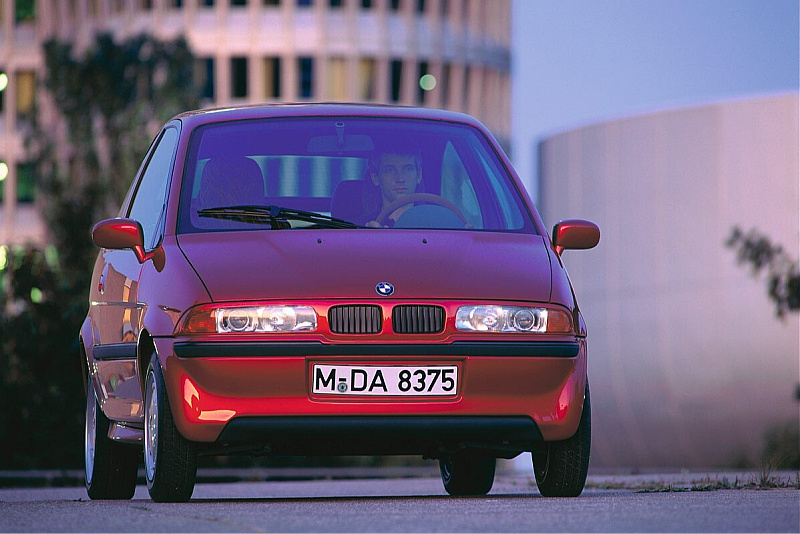
The first E1 featured a compact body with an unusually high roofline and only three doors. There were virtually no overhangs at either end, and although its compact dimensions helped reduce weight, it was achieved by using an aluminum chassis onto which a plastic body was mounted.
All of this contributed to weight reduction, but aerodynamics also had to be optimized to extract the best possible range from the batteries—the E1 achieved a drag coefficient of just 0.32.
Unfortunately, such small dimensions also compromised safety. Given that there was practically no space at the front or rear for crumple zones, smart engineering had to be employed to make the car crash-resistant. Areas that would typically be designed for crumpling had to be reinforced, while the main structure of the E1 was much stiffer than usual, with numerous side reinforcements.
Inside, things were very simple, with all controls grouped together in the central section, while the three dials that made up the instrument panel were clustered directly in front of the driver. Despite the E1's short length, it was a four-seater, with an unusually spacious trunk thanks to its low floor—the batteries were located under the rear seat.
However, the weight and capacity of these batteries were limiting factors, as they not only made up a quarter of the car's total weight of 880 kg but also could not provide a range greater than 200 km, which was still a significant achievement for the time. This was despite the fact that they were the most efficient batteries available at the time; sodium-sulfur units were up to four times more efficient than conventional lead-acid batteries. But it still wasn't enough.
The second E1 (MK2), unveiled at the Frankfurt Motor Show in 1993, was available in three versions: gasoline, electric, and hybrid. This concept was the result of combining the technology used in the first E1 with the body of the Z13, a concept BMW had introduced at the Geneva Motor Show in 1991.
There was also a new body design (changed from the first E1 and also different from the Z13), and by using aluminum for the main structure, it was possible to reduce the car's weight as much as feasible. The appearance and structure of all three derivatives were identical—the differences were solely in the powertrain. As for the electric version, the second-generation E1 didn't really advance the game; the new concept was little more than a redesign of the earlier car.
The electric E1 MK2 was powered by a 45 hp motor located between the rear wheels. This gave the car a top speed of 120 km/h and a range of up to 265 km, while the gasoline version was equipped with BMW's 1,100 cc, 81 hp engine. This engine was mounted above the front axle, which greatly facilitated the construction of the hybrid, as it retained the electric motor mounted at the rear. To save space and reduce weight, the hybrid E1 had a battery pack that was half the size of the one in the electric version.
Insufficiently developed battery technology and high costs simply weren't appealing to customers who would consider this electric BMW as the first car in their household, so everything remained at the concept stage. Nevertheless, the E1 served as an introduction to something BMW would commercialize more than a decade later—the i3 model.