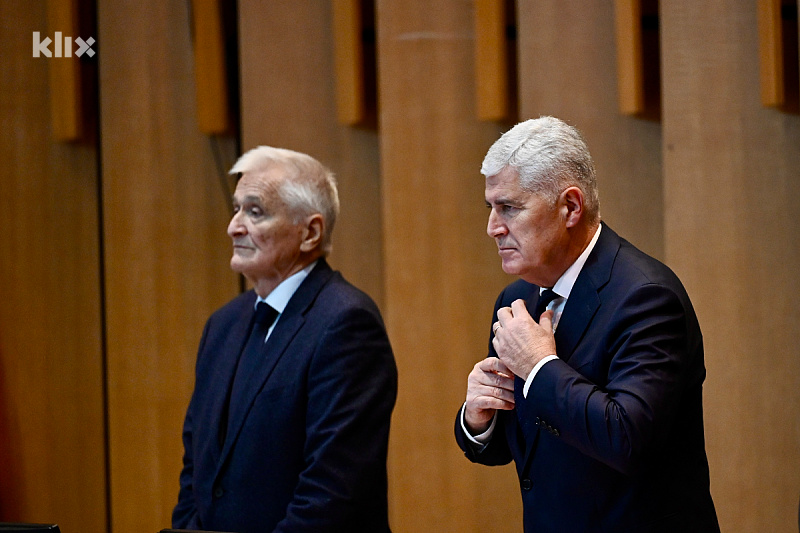
The situations in the House of Peoples of the Parliamentary Assembly of Bosnia and Herzegovina, as well as with the opening of the Gradiška Border Crossing, are representative and not exceptions, at least when it comes to an election year.
The state must come to a halt so that not a single potential vote is lost.
When an election year arrives, every decision that can be perceived as political will be under scrutiny because it can very well be exploited in the pre-election campaign.
Therefore, every vote, from various commissions to both houses of the state parliament, is weighed, analyzing how a "for" or "against" could affect the election results of the party they belong to.
In this context, the real implications of decisions become secondary, as we can see in concrete examples.
The House of Peoples of the PS BiH, with the exception of budget adoption, has been blocked for several months under the direction of HDZ and SNSD, and because of this, concrete measures that would have a positive effect on the citizens of BiH are at a standstill.
Delegates from these two parties, for political reasons, block amendments to the Law on Service in the Armed Forces of BiH, amendments to the Law on Excise Duties of BiH, the Draft Law on Restricting Disposal of Property to Prevent Terrorism, Financing of Terrorism, and Financing the Proliferation of Weapons of Mass Destruction, as well as many other solutions with concrete measures for citizens.
Similarly, ministers from SNSD at the state level, Staša Košarac and Srđan Amidžić, try to block the work of this institution at every opportunity.
On the other hand, Zijad Krnjić refuses to adopt a new regulation that would enable the opening of the new Gradiška Border Crossing, causing major traffic jams and delays at the border between BiH and Croatia.
Although it is difficult to compare the blockades of HDZ and SNSD with Krnjić's moves, who has a clearly predetermined condition for his "yes" vote, the result is the same: BiH is stuck in place, and citizens suffer.
The pre-election year is lost from the start.
No BiH politician wants to risk potential loss of personal and party votes by doing something that could be perceived as politically controversial.
On the other hand, opposing things that political opponents might consider important is also an excellent way to score points in the pre-election campaign.
Thus, an approach to politics that favors blockades is encouraged, and working on any progress can only bring negative points.
Returning to the example of the current blockade in the House of Peoples, SNSD will partly build its campaign on having "responsibly defended the Republika Srpska" at all levels, citing blockades by delegates in the House of Peoples, as well as Košarac and Amidžić, as fighting for the interests of RS.
Since the public service in RS is completely under the control of SNSD, as seen in reporting on these blockades, voters in this BiH entity will not get the full picture, but only the narrative of the ruling party. This tactic, repeated for several election cycles in a row, has proven extremely effective, as SNSD still has full control over processes in the entity and the state.
Even when SNSD cadres are partially constructive, as was the case with the adoption of the Growth Plan last autumn, it is packaged with announcements of future blockades, showing that this approach is not avoided even when the election year has not formally begun.
Every action has its reaction.
However, such an approach also leads to a reaction, as seen in public reactions to Zijad Krnjić's decisions.
Although a months-long blockade without clear reason is hard to compare with Krnjić's moves, who seeks things in accordance with BiH laws and regulations, his decisions to block the opening of the new GP Gradiška cannot be viewed in a vacuum, but also as a kind of reaction to the behavior of other actors in BiH.
Simply put, without the precedent set by SNSD and HDZ with their constant blockades, Krnjić would have already given up by now, and BiH citizens would already be passing through the new GP in the northwest of our country.
No matter how incomparable the moves of HDZ and SNSD on one side and Krnjić on the other are by many parameters, they can also be seen as two sides of the same coin, i.e., as action and reaction.
Citizens ultimately suffer the most.
In the end, the price of such political action, which has become normal in BiH, is paid by the citizens.
Besides not passing through the new GP, even though it is built and can be operational, BiH citizens will potentially have more difficult transactions (due to Moneyval's "grey list"), will not be a step closer to the EU (due to stalled European laws), and will pay for fuel that could be significantly cheaper (due to excise duties).
This situation will persist until the epilogue of the next elections, i.e., the formation of a new government after October. Even then, there is not much reason for optimism, but some things could potentially move from a deadlock, even if it takes a year.